Viser opslag med etiketten ethnohistory. Vis alle opslag

onsdag den 26. april 2017

The Aztecs did not need a leap year: Introducing the Nuttall-Ochoa model for the Aztec Calendar


This blogpost is inspired by a recent blogpost by Itztli Ehecatl at Calmecac Anahuac, in which he lays out the different calendar correlations between the Aztec/Mexica calendar and the gregorian one, and in which he argues in favor of the correlation recently made by Rubén Ochoa. I agree that Ochoa’s correlation is the best available, and in this blogpost, I describe why that is – recycling some of the arguments from Itztli Ehecatl’s blogpost and adding others.

Depiction of the Celebration of the feast of Tlacaxipehualiztli
during the Spring Equinox in the Codex Borgia (folio 34)

 A recurring question in the study of Aztec calendrics has been whether the Aztec calendar did or did not correct for leap years. Generally the question has been answered in the negative (see e.g. 
Sprajc 2000). Archaeoastronomer and expert in Mesoamerican calendars Anthony Aveni (2016:110), in his recent chapter on calendars in the  Oxford Handbook of the Aztecs, concludes that “there is little evidence that the Aztecs employed a leap-year correction”, but that the question is open.
Rather, I think the question is wrongly posed - who says the Aztec calendar even needed a leap year correction the first place?

The basic problem is that there is little explicit evidence that the Aztecs used an intercalary leap year in their xiuhpohualli solar year count, but also it seems that the monthly feasts, many of which were related to an agricultural cycle and themes were usually celebrated at the appropriate time of year for a given agricultural event. This poses a basic question of how to reconcile the idea of calendric agricultural rituals with a calendar count that cannot be fixed in relation to the tropical year.

But as I see it the question can be resolved quite simply by recognizing, as several scholars have, that the beginning of the Aztec year was fixed by the vernal equinox and that the nemontemi are simply the days between the end of the 360-day cycle and the beginning of the next. This would make the question of leap year moot for the Aztec calendar since the equinox/new year would automatically fix the calendar to the tropical year every year, and the need to have an explicit principle for intercalating days or months due to the increasing disjuncture between the astronomical and calendric year would never arise.

Currently, none of the most widely accepted correlations between the Aztec calendar and the Gregorian adopt this solution to the leap year problem. But the solution emerges naturally from the argument that the vernal equinox marked the beginning of the Aztec year.

Today, the most scholars use one of two correlations – Caso’s or Tena’s.  Alfonso Caso’s correlation does not correct for the bissextile year and so does not begin on a specific day relative to the Gregorian calendar, it would result in the Aztec year starting on a different day each year with the monthly ceremonies gradually changing their position relative to the tropical year.  Rafael Tena’s model, in turn, does correct for leap year, but he argues the year begins on February 26th with the veintena of Atlcahualo. 

Oddly, as noted by Itztli Ehecatl, neither Caso nor Tena cites Nuttall’s 1894 paper or her 1904 article in American Anthropologist in response to Eduard Seler. The argument against the intercalation of an extra day to correct for leap year is that some scholars find that it disrupts the ongoing count of the other calendrical cycles – the 260 day tonalpohualli and the lunar and venus counts. The argument for an intercalary day has mostly been the seemingly correct correspondence with sowing and fertility rituals in the spring months and the harvest rituals in the fall. Some scholars (e.g. Graulich 2002) have argued that the agricultural associations of the monthly feasts were so vague that they didn't really require being performed at a specific time of year (which is debatable), and that farmers don't need a calendar to tell them when to sow and harvest (which is right). 

Nuttall was the first to propose the equinox as marking the end and beginning of the Aztec solar year. Her proposal however has been echoed also by Lopez Luján (2005), who argues, based on the astronomical alignment of the Templo Mayor, and in accordance with Nuttall, that Tlacaxipehualiztli was the first 20-day month of the Aztec year and that its beginning was fixed by the equinox. 

Recently, Rubén Ochoa has verified that Nuttall’s correlation is consistent with the evidence from prehispanic calendric codices, and that the length of the nemontemi must have varied so as to gradually adjust to the tropical year. He notes that the addition of a day is evident in the relation between the two most securely dated events in Aztec history:  the arrival of Cortés in Tenochtitlan on November 8th 1519 (2 quecholli/8 ehecatl) and the fall of Tenochtitlan on August 13th 1521 (15 miccailhuitontli/1 coatl). He notes that counting from the first date to the second requires at least one intercalary day, which he supposes would have extended the nemontemi of one of the two interceding years with one day from 5 to 6 days.  The explanation of Ochoa’s model and the evidence from the codices can be found here and the evidence showing how the model works for the known dates around 1519-1521 is found here.

Nuttall however, followed the colonial chronicler De La Serna in believing that there was a 13-day intercalary trecena every 52 years, when the New Fire ceremony was celebrated. But as noted by Hassig, this would have had the effect of throwing the correlation between the agricultural year and the calendric year off so much that it would be impractical as an agricultural calendar. Hassig proposes that rather than resetting directly to the astronomical year, the New Fire Ceremony reset the year to 7 days earlier than the exact match, which would mean that the total variance between the agricultural year and the calendar would vary over the 52-year period, but without becoming greater than about 7 days which is agriculturally tolerable. The main problem with Hassig’s explanation is that it is entirely conjectural.

What sets apart Ochoa’s solution from those of de la Serna, Nuttall and Hassig is that when following the principle of beginning the calendar year on the day after the observable equionox, no explicit intercalation is necessary, nor are any calculations or record-keeping of a deep day count.  The intercalation arises naturally as the number of days between the end of the 360- xiuhpohualli and the beginning of the next after the equinox naturally varies between five and six days. For the Aztec commoner, the principle is simply that when the last day of the year is over, the waiting period for the beginning of the new year begins, and the waiting period ends when the priests calls that the sun is in the right position. Calendar priests will be aware that every four years there are six days before the equinox rather than the usual five, but since the nemontemi are already out of count and simply fill up the rest of the year, they do not need to make explicit mention of any “intercalation”, they simply keep counting the tonalpohualli day count and then restart the year count on the equinox. In this way, the Aztecs had a smoothly functioning calendar which could function without significant deviation from the tropical year, and which could be observed in all communities that shared the custom of beginning the new year on the vernal equinox, regardless of what month they used as the first in the year.

The Nuttall-Ochoa model has a number of major advantages over all previous calendar models:
  •  It solves the leap year problem without the necessity of explaining how the intercalation of days was accomplished without further confounding any existing mismatch between local calendar variants.
  •  It requires minimal astronomical knowledge to use since it can be maintained as a self-correcting system through the simple cultural practice of beginning the year count the day after the observable equinox, without the necessity of making calculations into the past or future or keeping records of bissextile years.
  •  It is congruent with the clear cultural relations between the calendar rituals and the agricultural cycle and the close cultural association between the year and the growth period.
  •  It is congruent with the archeologically attested importance of the equinox, and with the use of westward-oriented double temples that allow for ease of observation of the equinox sun between the two temples, and which symbolically divides the year into two deities who then represent the estival and hibernal solstices.
  • It is linguistically plausible based on the literal and cultural meanings of ‘nemontemi’ (“they vainly fill up”), and ‘xihuitl’ (year/herb/green(-stone)/comet).
  •  It is congruent with what we know about the practices surrounding the Maya solar calendar, including the architectural use of E groups as observation points from where the vernal equinox can be observed relative to the main temple structures.
  • It is congruent with the known correlation dates for the arrival of Cortés in Tenochtitlan in 1519 and the fall of Tenochtitlan in 1521.
      To me however the best argument comes from the Templo Mayor and has been used by Leonardo Lopez Luján to argue that the temple was tied to the equinox and to the calendar: If we assume that the Mexica new year started right after observing the spring equinox (usually march 21st in the Gregorian calendar), then the sun would rise exactly in between the two shrines on top of the Templo Mayor. AND: The feast for Huizilopochtli in Panquetzaliztli the sun would fall around the Winter Solstice when the sun would be above the Huitzilopochtli temple, and the feast for Tlaloc in Etzalcualiztli would fall on the summer solstice (during the rainy season in central Mexico).  With Ochoa's model, but not with any of the others, this would be the same year after year, without any need to discuss how to put the calendar back in sync with the sun. 

This image based on the official model of the Templo Mayor at the Museo Templo Mayor, shows how the sun would be observed from the Quetzalcoatl temple on the Equinox, and on the winter solstices - if Ochoa's model is correct.
Can this be a coincidence?

Finally, as a treat, here is a link to  Calmecac Anahuacs "Aztec Date app" which calculates any given date according to the Nuttall-Ochoa correlation. You can use it to find out what date you were born, married in the Aztec calendar.

Update (28/04/2017): Additional Arguments:

I have been encouraged to also mention the main arguments against the Nuttall-Ochoa correlation, so I will do this here. Traditionally it has been believed that the Aztec year was named after the day-sign (in the tonalpohualli ritual calendar) of the first day in the year. If we follow the Nuttall-Ochoa model, the first day of the year however is not the one that defines the year bearer - rather years seem to be named after the thirteenth day of the new year - this does seem a somewhat arbitrary principle, although thirteen is of course an important number.

Also a final argument in favor of the correlation , although a somewhat subjective one, is that in the Nuttall-Ochoa correlation and none of the others, my birthday falls on the Tonalpohualli day 13 Ozomahtli, about which the Florentine codex writes (in Anderson and Dibble's translation): "It was said that anyone who was born upon this day sign became a highly favored person; he succeeded and endured on Earth. He was well respected and recognized; he was famed and honored; hence he was one who prospered, enjoyed glory, was compassionate, and served others. As a chieftain, he was strong, daring in battle, esteemed, intrepid, able, sharp-witted, quick-acting, prudent, sage, learned and discreet; an able talker, and attentive. To everyone he brought happiness, as much as to comfort the afflicted and provide succor. And if such did not befall one, it was said that he himself, by his own doing, neglected and destroyed his day sign through vice, because perchance he took not good heed, perhaps did not perform the penances well.The closing day sign 13 Ozomatli was named Tonacatecutli. And likewise they said that the one then born would become aged; they said that he would finish his work, endure on Earth, and be admired" (Florentine Codex, vol. 4-5:53-54).

Bibliography:

torsdag den 1. januar 2015

Cacao: How a Single Word Holds the Key to Understanding the Mesoamerican Past

In this blog post I am going to summarize what is probably the most interesting example of how historical linguistics, in extreme this case the etymology of a single word, participates as evidence in the process of understanding ancient cultures.

A cup of hot Cacao with freshly made chocolate patties
on banana leaves in the back. Tlaquilpa, Veracruz 2014.
The word is question is cacao (or in English cocoa, a mangled version of the former with its own funny history), which describes the fruit of the tree Theobroma cacao, which in the form of chocolate  has provided a lot of deliciousness to people throughout the world.

The significance of this word is such that by determining its etymology, we have an important clue as to what language was spoken by the people who formed the first major civilization in Mesoamerica, the Olmecs.

Who created Mesoamerica?

Because the word has two different proposed etymologies, one that goes back to the deep past of the Mixe-Zoquean language family, and one that traces the word to the earliest Nahuan language, the word was become the lightning rod for the debates pitting the Nahuas and the Olmecs against each other as being the "founders of Mesoamerican civilization". 


Little chocolate figures in the shape of
 Olmec "colossal heads"
Specifically, one group of scholars argue that the Olmecs were a Mixe-Zoquean speaking people who cultivated maize, beans, squash and cacao and exported their knowledge and vocabulary to most of the other language groups in Mesoamerica. In this history the Nahuas originated in the U.S. Southwest and only entered Mesoamerica after the civilization had been established by speakers of Mixe-Zoquean, Otomanguean and Mayan languages. Another group of scholars argue that Uto-Aztecan speakers were among the original founders of the culture area, and that they were among the most politically and culturally important groups already in the formative era (starting about 2000 BCE, and becoming the Classic period around 200 CE), and that they might have been the main group behind the rise of the mega-empire of Teotihuacan (Teotihuacan collapsed around 600 CE). 

Cacao beans still in the pod.
The way civilizations have started in the world is generally through the development of new ways of making food that are easier and more efficient than older ones and which allow for population increase.  In Mesoamerica these innovations were the cultivation of maize from from wild species of grass, and the cultivation of squash and beans. This happened sometime between 3000 and 2000 BCE and led to people becoming sedentary, building villages and later towns with central governments. From around 2000 BCE the first major monuments and monumental architecture begins to be found in the gulf coast region of Mexico, and this culture with its distinct style of stone monuments is what archeologists call the Olmec culture. Its innovations and styles spread across Mesoamerica over the next period, being absorbed into local styles. This has led some archeologist to consider the Olmecs to be the "mother culture" of the Mesoamerican civilization, although others like to consider it only a "big sister" whose good ideas were accepted and used by the other siblings who had developed the main ingredients of civilization independently. 

So what does all this have to do with Cacao?

Cacao in Mesoamerica:

A maya ruler receiving his hot kakaw
 from a servant on a classic period vase.
Across Mesoamerica Cacao has
been associated with wealth and power,
even to the point of cacao beans being
used as a form of currency.
Just like maize, beans and squash, cacao is indigenous to Mesoamerica, and has been cultivated from wild species. But unlike these other species cacao is not a staple crop that provides nutrients necessary for basic survival, rather it is a luxury crop, that provides delicious theobromine for the nervous system at the expense of a laborious process of cultivation and processing. This means that the presence of cacao demonstrates that a culture has moved beyond the stage of bare necessities in generated a surplus. The generation of surplus in turn marks the beginning of class division and hierarchy, and a complex division of labor - the social signs archaeologists associate with the phenomenon we call "civilization". Therefore, signs of the consumption of cacao is a kind of litmus test for when and where Mesoamerican civilization can be said to have begun. 


Vessels tested positive for theobromine from San Lorenzo,
Powis, Cyphers et al. 2011.
As it is, we find the first signs of cacao cultivation and consumption among the Olmecs in the sites of El Manatí, and at San Lorenzo between  1800 and 1000 BCE. The signs are sure that it was cultivated for consumption because archeologists have found ceramic vessels with residue traces of theobromine, the active ingredient of cacao.
So the Olmecs were definitely into the chocolate rush. But what did they call this delicious addiction?


The word Cacao in Mesoamerica:

The Maya word kakaw spelled in
hieroglyphs as KA -KA-WA
The reason not only the fruit cacao is interesting but also the word is that almost all Mesoamerican languages have a very similar sounding word for it. This suggests that all these come from a single source. And if all Mesoamerican languages have their word for Cacao from a single source then it is logical to assume that they received the both word and the fruit it described from the same source as well. So basically it appears that the Olmecs exported both their ideas and their words to the rest of Mesoamerica. The trick then is to find out what language the Olmecs spoke - which is easier said than done since it is hard to determine which of the many languages that have similar words is the original one.

Note how similar the word for cacao is in different Mesoamerican languages (Source Kaufman & Justeson 2007):
  • proto-Zoquean - *kakawa;  
  • proto-Mixean - *kakaw;
  • Nahua - /kakawa-tl/; 
  • Mazahua - /kakawa/; 
  • proto-Mayan, Totonac, Salvador Lenka - /kakaw/;
  • Paya/pech - [kaku]; 
  • Purhépecha: - /khe´kua/. 
  • Boruka, Tol,-  and Honduras Lenka -  [kaw]


So where did the word originate?


The Mixe-Zoque hypothesis:
Cigar-smoking Maya
monkey-deity
holding a cacao pod.
In a hugely important 1976 paper Lyle Campbell and Terrence Kaufman proposed that the Olmecs had spoken proto-Mixe-Zoque, the language that became the ancestor of the Zoquean and Mixean languages of southern Mexico. The argument was based on the observation that a number of important culture words could be demonstrated to have diffused  throughout Mesoamerica, and the evidence suggested that the diffusion was from Mixe-Zoquean languages into all the other ones. This was the paper that made the Mixe-Zoque languages, which had earlier been considered inconsequential and hardly even considered, a serious contender for the "Olmec question". Importantly, this argument doesn't hinge on the word for Cacao alone, because also words for other important cultivars such as gourds, squash, tomato and bean were traced to Mixe-Zoque along with several other important cultural concepts such as words related to maize preparation, to religion and to material culture. Previously many had considered it most likely that the Olmec spoke a Mayan language and that there was a direct continuity between Olmec and Maya cultures.


The Nahua hypothesis:
Tlapalcacauatl "red cacao"
from a colonial Nahuatl herbary
.
In 2000 Karen Dakin and Søren Wichmann proposed specifically that the word Cacao did not originate with Mixe-Zoquean as proposed by Campbell and Kaufmann 24 years earlier, but that it had originated with a Uto-Aztecan language, probably Nahuan. They argued that if proto-Mixe-Zoquean had indeed had the word *kakawa, then most of the dauhgter languages would have irregularly derived forms of the original word. Rather they suggested the word had probably been borrowed by Mixe-Zoque speakers from some other language, leading to the irregularities they observed. They then looked at Uto-Aztecan language and found that many of them have a word for 'egg' that can be reconstructed as *kawa or *kapa. Nahuatl in fact is one of the only languages that do not have a word for 'egg' based on this stem (usually having either totoltetl "bird-stone", or tekwsistli originally meaning conch). They then argue that Nahuan kakawatl could be derived from an earlier Nahuatl word kawatl 'egg' (a word which is not actually attested) and that the reduplication of the -ka- could have originated from the process that makes nouns that are described as similar to what ever is being reduplicated. I.e. kakawatl could have originally meant "that which is similar to an egg". Cacao beans, although physically very different from eggs in color, size and shape, do have a thin shell that has to be removed after toasting, which can perhaps be considered similar to an eggshell. They took this argument to show that Nahuas had been present in Mesoamerica and played a major role already during the classic period, probably being associated with the empire of Teotihuacan, which they considered the source from which the Nahua word had spread to other languages including Mixe-Zoque and Maya. 

In 2001 Jane Hill proposed that contrary to received wisdom which considered the Uto-Aztecan languages to have originated in the U.S. Southwest with proto-Nahuatl speakers migrating southwards into Mesoamerica eventually taking up agriculture and many cultural traditions of the Mesoamericans, instead the opposite had happened. Hill argued that proto-Uto-Aztecan had been spoken in Mesoamerica and that its speakers had participated in develoiping Mesoamerican civilization whereafter a large group of Uto-Aztecans migrated northwards eventually giving up agriculture for a hunter-gatherer lifestyle. Her argument was that in her reconstruction of the language family's history, some maize related words could be recostructed all the way back to the Uto-Aztecan proto-language. 

In 2005 Martha Macri argued that three words in a very early Mayan glyphic text (from 480 AD) could be considered Nahuatl loans into Mayan, and that these words were all related to Cacao. The words in question were WITIK(I) which she related to Nahuatl /witeki/ "to beat something", MULUL which she related to Nahuatl /mo:lli/ "ground spice sauce" (sometimes containing Cacao), and KOXOM(A) which she related to Nahuatl /koxo:ni/ "for a hollow vessel to make a sloshing sound" or /koxo:nia/ "to stir a pot".  I must admit that personally, I find Macri's proposal completely unconvincing because none of the words have more than a speculative relation to cacao, they are not documented in any contemporary Mayan languages as loans, and because there is  not a good fit between the form of the proposed Nahuatl source and the given maya syllables, it seems unlikely that the words would be loaned in this form since they require loaning the verbs as stems and not as fully inflected verbs,  and finally because at least two of them actually have completely plausible Maya meanings and etymologies. I think Macri's proposal can be safely ignored, which most subsequent scholarship has also done. 

Nonetheless throughout the early 2000s there was a general sense that the tide was turning against the Mixe-Zoquean hypothesis and that probably Nahuas had been present in Mesoamerica earlier than was generally thought.  


Mixe-Zoquean strikes back:
But Terrence Kaufman would have none of it. He maintained vigorously that the Mixe-Zoquean hypothesis was solid. First in 1993 he and John Justeson had published an elaborate deciphering of the undeciphered Epi-Olmec (meaning late Olmec) or Isthmian hieroglyphic script arguing that it was written in the proto-Zoquean language. This would seem to be a serious piece of support for a Mixe-Zoquean-Olmec connection.  The decipherment was nonetheless contested by some Maya archeologists who were unable to read a third text using the proposed decipherment (Houston & Coe 2004). 


Doña Cristina, of Tlaquilpa, Veracruz,
 grinding Cacao with the toasted beans
in front and a calabash full of cinnamon.
The chocolate paste comes out of the grinde
and is mixed with sugar. 
In 2007 Justeson and Kaufman published a forceful rebuttal of Dakin and Wichmann's argument. They argued that the proposal of the Mixe-Zoquean as the donor language was solid both because in their reconstruction it fit well with the forms in the Mixe-Zoquean daughter languages and because it was supported by the fact words for many other cultigens could be demonstrated to have been most likely diffused from Mixe-Zoquean. (Wichmann actually agrees with Kaufman that the Olmecs spoke Zoquean and has provided evidence for that himself, so the disagreement for Wichmann seems to be mostly about the presence of Nahuas at Teotihuacan and the specific etymology of the word cacao). They also argued that the proposal deriving kakawatl from egg was untenable. They show that proto-Nahuatl had many borrowings from Mixe-Zoquean, and that even setting the word kakawatl aside all other loans from Nahuatl into Mesoamerican languages postdate the classic period. This seems to establish that there is a general pattern of Mixe-Zoquean influence on Nahuan dating to the classical period, but no general pattern of Nahuan influence on other languages in the classical period. They argue that if the Uto-Aztecan word 'egg' which they reconstruct as *kava had been derived regularly into Nahuan it would not have given /kakawatl/ but /*kaka:tl/ - the derivation proposed by Dakin and Wichmann, they consider to be impossible. Furthermore they show that when other Mesoamerican languages do borrow words from Nahuatl they do so with the absolutive suffix attached, i.e. the Nahua and Mixe-Zoquean forms should have been *kakawat and not /kakaw/. 

In 2009 Justeson and Kaufman published another intense counter argument, refuting in toto, Jane Hill's proposal of Uto-Aztecan originating in Mesoamerica (which had already attracted general dissaproval from Uto-Aztecanists), by showing that her Maize related reconstructions could only be dated to proto-Southern Utp-Aztecan, but not to the common ancestor of all Uto-Aztecan languages. Although Kaufman and Justeson did accept a slightly earlier date for the entry of Nahuas into Mesoamerica than they usually had (originally they considered Nahuas to have arrived around the time of the fall of Teotihuacan, but in 2009 ).  This, coupled with a wide set of other rebuttalls to Hill's theory, again shifted the balance to see Nahuas as latecomers in Mesoamerica, and Mixe-Zoquean speakers as the drivers of the Olmec "mother culture".

Further arguments were presented by Dakin in 2010 arguing for Nahua influence in the Mayan lowlands during the classic period. And in 2010 and 2012 Hill published again an argument to the effect that proto-Uto-Aztecan was a Mesoamerican language. Her maize related etymologies have meanwhile been rejected by scholars such as William Merrill (2012, Merrill et al. 2009), and Lyle Campbell (Campbell & Poser 2008). 

So what is the status? Confirmation Bias and its effects:

Too most ordinary people, including here most archeologists, historians and linguists, these debates simply look like a big pile of "my kung fu is stronger than your kung fu" - hard to make head or tails of.  This is because it requires intimate familiarity with both a vast number of languages, as well as the methods of historical linguistics, to judge which claims are better founded than others. 

I think that in the end, what will make most people side with one of the proposals is probably less about the soundness of the historical linguistics behind the proposals, and more about which story of the Mesoamerican past they prefer for their own personal reasons, whether aesthetics, preferences or experiences with one or more of the ethnic groups or scholars involved etc. 

Humans are funny that way. We are very quickly convinced by any evidence that points us in the direction we already want to go. 

Personally, I count myself on the Mixe-Zoque team for the time being. This may actually be because I know less about Mixe-Zoque than about Nahuatl and Uto-Aztecan, which means that I am more critical of the proposals involving Nahuatl, than of the ones involving languages I know less about. I have found the proposals of Dakin and Wichmann, Hill and Macri to be unconvincing in the ways they stretch meanings and forms to create what to me comes across as speculative etymologies. For example to get from *kava "egg" to *kakawatl "cacao" there are at least two leaps of faith, first the idea that they could be conceived as similar, and secondly the fact that the *kawa "egg" etymon is not attested in Nahuan at all - one such leap I might be willing to accept, but not two. Maybe Kaufman does the same kind of etymological twisting with Mixe-Zoquean, but I am unable to see it, and I am more convinced by his Nahuatl work.

My main point with this blog post is to demonstrate how historical linguistics is far from an exact science, but an interpretative science, where different scholars interpret the same facts differently based on their background knowledge.

And also to show how a single word for a fruit and a delicious beverage can become the key to such a highly political question as identifying the speakers of one language or another as the founders of the Mesoamerican civilization.

Bibliography:

  • Campbell, L., & Kaufman, T. (1976). A linguistic look at the Olmecs. American Antiquity, 80-89.
  • Campbell, L., & Poser, W. J. (2008). Language classification. History and method. Cambridge.
  • Coe, S. D., Coe, M. D., & Huxtable, R. J. (1996). The true history of chocolate. London: Thames and Hudson.
  • Dakin, K., & Wichmann, S. (2000). Cacao and chocolate. Ancient Mesoamerica11(01), 55-75.
  • Dakin, K. (2010). Linguistic Evidence for Historical Contacts between Nahuas and Northern Lowland Mayan Speakers. Astronomers, Scribes, and Priests: Intellectual Interchange Between the Northern Maya Lowlands and Highland Mexico in the Late Postclassic Period, 217.
  • Hill, J. H. (2012). Proto-Uto-Aztecan as a Mesoamerican language. Ancient Mesoamerica23(01), 57-68.
  • Hill, J. H. (2001). Proto‐Uto‐Aztecan: A Community of Cultivators in Central Mexico?. American Anthropologist103(4), 913-934.
  • Houston, S. D., & Coe, M. D. (2003). Has Isthmian writing been deciphered.Mexicon25(6), 151-161.
  • Joyce, R. A., & Henderson, J. S. (2010). Forming Mesoamerican Taste: Cacao Consumption in Formative Period Contexts. In Pre-Columbian Foodways (pp. 157-173). Springer New York.
  • Justeson, J. S., & Kaufman, T. (1993). A decipherment of Epi-Olmec hieroglyphic writing. Science259(5102), 1703-1711.
  • Kaufman, T., & Justeson, J. (2007). The history of the word for cacao in ancient Mesoamerica. Ancient Mesoamerica18(02), 193-237.
  • Kaufman, T., & Justeson, J. (2001, March). Epi-Olmec hieroglyphic writing and texts. In The Proceedings of the Maya Hieroglyphic Workshop: The Coming of Kings; Epi–Olmec Writing, March 10–11, 2001, University of Texas at Austin(pp. 93-224).
  • Kaufman, T., & Justeson, J. (2009). Historical linguistics and pre-Columbian Mesoamerica. Ancient Mesoamerica20(02), 221-231.
  • Macri, M. J. (2005). Nahua Loan Words from the Early Classic Period: Words for cacao preparation on a Río Azul ceramic vessel. Ancient Mesoamerica,16(02), 321-326.
  • Merrill, W. L. (2012). The historical linguistics of Uto-Aztecan agriculture.Anthropological Linguistics54(3), 203-260.
  • Merrill, W. L., Hard, R. J., Mabry, J. B., Fritz, G. J., Adams, K. R., Roney, J. R., & MacWilliams, A. C. (2009). The diffusion of maize to the southwestern United States and its impact. Proceedings of the National Academy of Sciences106(50), 21019-21026.
  • Powis, T. G., Cyphers, A., Gaikwad, N. W., Grivetti, L., & Cheong, K. (2011). Cacao use and the San Lorenzo Olmec. Proceedings of the National Academy of Sciences108(21), 8595-8600.
  • Wichmann, S. (1995). The relationship among the Mixe-Zoquean languages of Mexico. University of Utah Press.


søndag den 28. december 2014

Quetzalcoatl: Precious Twin?


It is commonly asserted that a possible meaning of the name of the deity Quetzalcoatl is "precious twin". Sometimes it is even claimed that this is the real meaning and that the more commonly given meaning "Feathered Serpent" is false. In this blogpost I take a look at the history of this claim and its validity.


The claim is found in many different places: 

Historian Enrique Florescano states in his 2002 "The Myth of Quetzalcoatl" that "Uniting into one single entity the attributes of the serpent and the bird, metaphorically combining both the germinating powers of the earth and the creative powers of the sky, the Plumed Serpent became synonymous with the Precious Twin" (p. 147) 

Nahuatl translator John Bierhorst states in his 1974 "Four Masterworks of American Indian Literature" takes it as an example of the multifaceted meanings of Nahuatl metaphors: "The name Quetzalcoatl means literally "plumed serpent" from quetzalli, feather of the precious green quetzal, and coatl , a snake". ... A particularly ingenious reinterpretation, involving a double pun, transforms "bird-snake" into "precious twin", an epithet of the morning star considered the twin of the evening star (quetzal = "quetzal" or "precious", coatl = "snake" or "twin")" (p. 4)


The idea is not new either, in 1908 anthropologist H. Beyer published an article about the "symbolic meaning of the dog in ancient Mexico" in which he stated that  "Xolotl is the twin-brother of Quetzalcoatl, and vice versa. Therefore Xolotl became the 'god of the twins', and Quetzalcoatl’s name can be translated not only as 'plumed serpent' but also as 'precious twin'.”


And in the more extreme form denying the meaning "plumed serpent" it is found in discussion fora on the internet:  "Another lie. Quetzalcoatl was not white, he made no prophecy, he didn’t promise to return, and his name does not mean ‘feathered serpent.’ The name means ‘precious twin’. The myth that Quetzalcoalt promised to return is a total fabrication--a post-conquest myth contrived by Spanish missionaries to facilitate their conversion of Indians." (2012 discussion forum)


So lets look a bit at what the evidence for this secondary meaning actually is.

Everyone agrees that the name Quetzalcoatl is composed of two roots quetzalli /ketzal-li/ and coatl /ko:wa-tl/.  What is less clear is what exactly the meanings of those two words are.

Related to the verb quetza /ketza/ "to stand/put upright", the meaning of the word quetzalli is given by Molina as "pluma rica, larga y verde" (Long, green, rich feather). The relation probably refers to the way that feathers stand up from the skin of the bird. In the Florentine Codex we find sentences such as "in quetzalli īhuān in nepapan tlazohihhuitl " (the quetzalli and the other precious feathers),  or the description of the feather seller at the market "quināmaca in quetzalli in chīlchōtic, in tzicoliuhqui, in pilihhuitl"  (he sells the quetzalli, the chili-green-colored, the curved, the young feathers) and "ca ixachi inin tōtōtl īquetzallo" (they are huge that bird's feathers) (I have the examples from the Florentine from Wimmer's dictionary under the entry "quetzalli"). This should show adequately that the meaning is primarily related to a particular kind of long green feather which is highly valuable for decorative purposes.  According to Sahagun the metaphorical usages of the word quetzalli were as a reference to an unborn child, and as a form of address when addressing the Tlatoani "Quetzallé!". This does suggest that it was used to express feelings of deep appreciation similar to calling somone "my treasure" or "my jewel". However I have found no examples of usages of "quetzalli" as modifier with the meaning "precious". In compounds it always seems to refer directly to the quetzal feather itself , e.g. quetzalcomitl "a recipient for holding feathers" or quetzalcopilli "feathered headdress" (one possible exception is the word quetzalitztli, describing a kind of precious stone, but I wonder if we can assume that quetzal- necessarily means "precious" in the Nahuatl word, it might well refer to some other property of the stone, perhaps a green color - or to the original literal meaning of quetzalli as "something that stands upright"). 


The word coatl /ko:wa:tl/ (with the plural form cocoua /ko:ko:wa
ʔ/) however clearly has two meanings, "snake" and "twin". Molina gives it in several instances both in the Spanish and Nahuatl parts of his vocabulario: 
- Geminos,hermanos nacidos de vn vientre. - Cocoua.
- Mellizo - coatl
- Cocoa - culebras o mellizos.
- Coatl.- culebra,mellizo,o lombriz del estomago
The usage of "twin" lives on in Mexican Spanish as cuate "twin/close friend".

So half the translation holds, Quetzalcoatl could be translated as "feather twin", which would not be weird given the fact that he is described as being the twin of the dog-deity xolotl, and that he was related to the planet venus which was considered a twin-star with different twins appearing in the evening and the morning.


But where does the "precious" aspect come into play? How and when was it suggested that the word for "precious feather" could be used to mean simply "precious".


Here we have to go even further back in the literature. 

Jacques Lafaye in his "Quetzalcoatl and Guadalupe" points us to a manuscript called El Fénix de Occidente: Santo Tomas descubierto con el nombre de Quetzalcoatl written by the Jesuit Manuel Duarte in the second half of the 17th century (Lafaye argues that it was not written by Carlos Sigüenza y Góngora to whom the text is usually attributed).  In this manuscript Duarte was determined to demonstrate that the native people of New Spain were not strangers to the Christian Gospel. Many friars had a hard time believing that God could have left an entire hemisphere devoid of his word for 1500 years, and they looked for signs to suggest that  they had in fact been subject to evangelization which they had then subsequently forgotten.

Duarte was convinced that Saint Thomas the apostle, who was known to have preached in India, had also reached the West Indies, and converted the natives to Christianity and he looked for all the evidence that he could find for this thesis. In the myths of Quetzalcoatl he found exactly what he was looking for. The idea that Quetzalcoatl was in fact St. Thomas had already circulated among the Franciscans and Dominicans (e.g. Diego Durán)  as a quiet heresy, but Duarte made it explicit. He argued that apart from the ways that the figure of Quetzalcoatl as bringer of knowledge and light, and his relations to the human prince called Topiltzin suggested that the myth had its origin in the figure of of a religious man, the very name of Quetzalcoatl was indeed the same as St. Thomas. He derived the name Thomas from the Greek form of the Aramaic name תָּאוֹמָא (Ta'oma') which means "twin", corresponding also to the greek didymus "twin".  Here was a clear correspondence between the two! But what about the Quetzal part? What did that respond to?  It seems that Duarte in his eagerness to make the two parts fit, considered quetzalli with its connotations of appreciation and value corresponded to the title "Santo" (Saint/Holy). Quite a stretch when you think about it. 


The idea of Quetzalcoatl being a European Christian missionary is also found in the work of Bartolomé de las Casas, who nonetheless does not give the translation "precious twin" or suggest that it wa specifically St. Thomas. Rather Las Casas states that Quetzalcoatl refers to a certain kind of snake which has a feather on top of its head, and which is mostly found in the tropical province of Xicalango.


So no, Quetzalcoatl, cannot and does not translate to "precious twin", 

The idea behind this translation can be traced back to the millenarian heresy of the Franciscans (which is also the origin of the erroneous ideas that Quetzalcoatl was blonde, and that he promised to return and that the Aztecs thought that Cortés was the returning Quetzalcoatl/St. Thomas). It is extremely unlikely that any native Nahuatl speaker in the 16th or 17th century would have considered Duarte's etymology to make any sense. They might have accepted the idea of coatl as a double entendre connoting subtly his status as a twin, but it is unlikely that they would ever consider quetzalli to mean anything other than "precious green feather". So indeed they must have thought of the deity Quetzalcoatl as being characterized by plumage, and to have the dual aspect of a twin and a snake. 

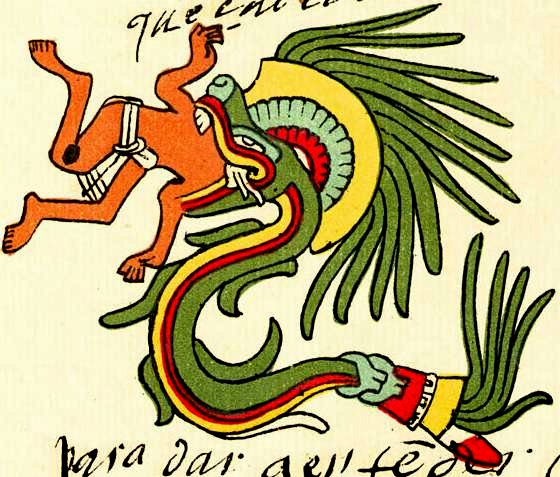
Thus it is not surprising to look at the way Quetzalcoatl was depicted in the codices, either as a snake or a man, but in both cases decorated by long, rich green feathers.


[Thanks to the readers of the Nahuat-l listserv 
who responded to a query of mine regarding this issue, 
and pointed me on the way towards the facts. 
I have also made some corrections in 
response to comments from the list.]


Quetzalcoatl as Snake in Codex Telleriano Remensis
Quetzalcoatl as human in Codex Telleriano Remensis


onsdag den 26. november 2014

Decline of Nahuatl in Morelos (part II)

In my previous post I argued that the state of Morelos was predominantly Nahuatl speaking in 1910. As we know, that is not the case anymore.

In this post, I use three sources to show the decline of Nahuatl in Morelos from 1897 to 2014 graphically.

The earliest source is an 1897 Nahuatl wordlist compiled by Antonio Peñafiel, on the map I plot in all the communities where he collected Nahuatl vocabulary. As a minimum we know that there were Nahuatl speakers in those locations in 1897. In 1941 anthropologist Robert Barlow was involved in a project meant to teach Nahuatl language literacy to the Nahua of Morelos. He tested a group of teachers and the locations of the towns where they were from is plotted in on the map. In 1976 Karen Dakin and Diane Ryesky surveyed Nahuatl in Morelos and found Nahuatl speakers in a couple of communities that I haven't put on this map yet, in Axochiapan and Atlacholoayan. And then today Nahuatl is spoken in 6 communities of which Cuentepec is the only one where it is the main community language spoken by all age groups. In Tenextepango in the municipality of Ayala, the speakers are all originally from Guerrero who arrived in the state within the past 40 years.


I have plotted the towns into this map of the state of Morelos, using different colors to distinguish the age of the last attestation of Nahuatl spoken in the locality in the sources I use. They give a visual representation of the process of decline, starting from the lowlands that were most severely affected by the violence of the revolution. 

Today revitalization efforts are undertaken in Hueyapan,  Xoxocotla, Tetelcingo, Sta. Catarina, Ayala/Tenextepango, and in Coatetelco - so the map may look different 50 years form now again.

Here is my map (please don't use it without attribution to me):


tirsdag den 18. november 2014

Of Statistics, Lies and Genocide: How many Nahuas lived in Morelos before the Revolution?

[This post is based on work in progress, so if you would like to cite the material or argument, please contact me by email first to get the most recent version of the argument, and my permission]

The way that statistics can be used to create reality is well known, and so is the way that censuses can be used to make inconvenient segments of the population look less significant than their actual numbers suggest. Many Native American scholars have made incredible efforts trying to create realistic estimates of indigenous American populations at different times in history (Russell Thornton's work is particularly excellent). But this endeavor is always difficult due to the challenges of finding out how well census data actually represents native populations. 

A group of Zapatista soldiers.
Pedro Lavana came from the Nahua
community of Hueyapan, Morelos.
Courtesy of the Casasola Collection.
In this post (based on a part of the history chapter of my dissertation), I look at how the indigenous Nahua population of Morelos has been counted and represented before during and after the Mexican Revolution. This is an important topic because it speaks to the question of how much indigenous involvement was a part of the Zapatista movement. Since the seminal study of John Womack "Zapata and the Mexican Revolution" (1969), the consensus has been that the Zapatista movement was primarily a mestizo agrarian rebellion. But in this post I aim to demonstrate this to be completely false. Womack based his idea of the rebellion on a misreading of census data that caused him to vastly underestimate the indigenous element of the population of Morelos in 1910. 


Womack (1969:71) dedicates but a footnote to the ethno-linguistic composition of Morelos at the turn of the 20th century, and to the question of Zapata's possible relation with the Nahuatl language. He cites a 1962 UNAM master's thesis in geography that analyses census data in Morelos from 1900 to 1930. From this work, which I have not been able to consult, he extracts the information that Nahuatl speakers only made up 9.29% of the population of Morelos at the time the Revolution broke out. He also cites Sotelo Inclán's description of Zapata traveling to the village priest in Tetelcingo to get his help in deciphering the ancient Nahuatl titles of Anenecuilco, as evidence that Zapata did not know a word of Nahuatl. He claims that when the morelenses heard Madero's statement that he would return the lands appropriated by the haciendas to the indians, they interpreted “indian” to be simply the way city people referred to the rural peasantry but that they otherwise did not recognize their state as particularly Indian.

The 1900 Mexican census did collect data about indigenous languages spoken. So far Womack is on the right track. The census questionnaire (which is available online here) provided a field with the title “Idioma nativo o lengua hablada”, the instructions to the person administrating the census stated clearly the procedure for filling out the field: 

En la columna 11 debe escribirse el nombre de la lengua nativa ó hablada comunmente, como castellano, francés, inglés, etc., ó bien el nombre del idioma indígena, como por ejemplo el mexicano ó nahuatl, el zapoteco, el otomí, el tarasco, el maya, el tzendal, el huasteco, el totonaco, etc., etc. A la persona que hable el castellano y un idioma indígena, como el otomí ó el mexicano ó cualquier otro, se le anotará de preferencia el castellano.” [In column 11 should be noted the name of the native or commonly spoken language, such as Spanish, French English etc. Or also the name of the indigenous language, such as Mexicano or Náhuatl, Zapotec, Otomí Tarascan, Maya, Tzeltal, Huastec, Totonac etc. For the person who speaks Spanish and an indigenoys language such as Otomi, Mexicano or any other, Spanish will be noted by preference. (my emphasis).]

 These instructions meant that for bilingual persons only Spanish should be noted, which in turn means that the percentage figure given for speakers of Nahuatl includes only monolingual Nahuatl speakers, whereas bilingual Nahuas (and any ethnic Nahuas who did not speak the language) are counted as Spanish speakers. In 1900 using this way of counting, the number of speakers of indigenous languages was 16,9% monolingual Nahuatl speakers. Today, there are few communities with percentages of monolingual speakers of indigenous languages as high as 16% and in those communities the vast majority of inhabitants tend to speak Nahuatl as a first language and Spanish as a second language. Towns with similar numbers of monolinguals are found in for example in the Zongolica region, where census figures today suggest that a breakdown of 10% monolinguals would correspond well to a demographic composition with 10-20% monolingual speakers of Spanish and 70-80% Spanish/Nahuatl bilinguals. Given that the state of Morelos had 161,000 inhabitants in 1900, that would suggest a composition with approximately 16,000 monolinguals, and at probably least 100,000 bilingual Nahuas in the state.

However in the 1910 census, which seems to have used the same questionnaire, for some reason the number of Nahuatl speakers in Morelos declined to 9%, only to jump back up to 14% in the 1930 census, the first one after the revolution. There is no record of any events in Morelos in the period that would have plausibly caused the Indigenous population to drop by almost 40% in this ten year period. The same abrupt jump in the reporting of indigenous people is found in most of the states in the 1910 census. This seems to suggest some kind of irregularity with the 1910 census. Probably this means that the census for practical or logistical reasons did not adequately sample the rural population at this time. In any case, the figure of 9% is an anomaly that seems to under represent Nahuatl speakers by about 5%. And at the same time, contrary to what Womack clearly believes, it does not pretend to provide the total number of Nahuatl speakers, only the number of monolingual speakers. 

This of course means that when Womack takes the percentage of monolinguals to refer to the total number of speakers he is vastly underestimating the number of Nahuatl speakers of Morelos. And in contrast to his glib assertion that there were hardly any Indians there, we would be justified in considering at least 70% of the population of 161,000 people to have been Nahuatl speakers. This suggests that contrary to Womack's assertion, it is quite likely that Zapata spoke Nahuatl, and the eyewitness testimony of Doña Luz Jiménez which Womack also ignores, corroborates that he did. 

In the 1930 census the questionnaire gave the possibility of recording two languages, first whether the respondent spoke the national language or not, and then in the second slot which other language they spoke. This means that for 1930 the figure of 14% Nahuatl speakers includes both monolingual and bilingual speakers. The total population of Morelos in 1930 was 130,000, 30,000 less than before the Revolution. Based on the percentages of Nahuatl speakers we can estimate the indigenous population of Morelos at ca. 100,000 in 1910 (possibly more, including both bi- and monolingual speakers), and we can show that after the war it had been reduced to less than 20,000 (also including both mono and bilinguals).

Given the relatively modest decline in the total population from 1910 to 1930 this figure of an 80% indigenous population loss may seem exaggerated. But the population loss is hidden in the censuses because they don't take into account the influx of out-of-state people in the 7 years following the Revolution. The fact that indigenous population loss was much greater than what the raw population figure suggests is also shown by cohort analyses that show that the people counted in 1910 are not the same as the ones counted in 1930. For example of the 90,000 women counted in Morelos in 1910 only 35,000 were counted again in 1930 (McCaa 2003). This points to a drastic decline in native born (mostly Nahuatl speaking) Morelenses and their replacement of people from other states after the war. The argument could be further supported if the portion of Morelos residents born out of state could be shown to have increased drastically from 1910 to 1930, but unfortunately I have not been able to find this piece of information in the census even though the census did ask for state of birth.

This is a clear example of how census data can be used to mask what was essentially a genocidal event, and to mask the participation of indigenous peoples in National history.

*Womack, J. (1969). Zapata and the Mexican revolution. Random House LLC.
*McCaa, R. (2003). Missing millions: the demographic costs of the Mexican revolution. Mexican Studies19(2), 392-93