onsdag den 8. juni 2016

Aztec Writing: How does it really work?

I have never written on this blog about colonial or precolonial Nahua iconography or glyphic writing. This is partly because I tend to find codices boring, prefering to work with spoken language, and partly because other people are much more knowledgeable about these things than I am. Recently, however, I have started reading up on this, and had some talks with some specialists in Nahua writing. So here comes my attempt to describe the current debates within the field of Nahua writing studies.

First of all perhaps we need to point out what we mean by Nahua glyphic writing - most Nahua texts are of course written in Latin letters - but here we mean texts written with non-European signs. In the codices this kind of writing abounds, mostly used to write personal names and the names of places.
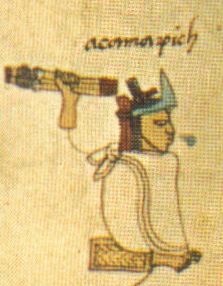
The name of Acamapichtli "handful of reeds",
ruler of Tenochtitlan,  written with
glyphs  and Latin letters.
The glyphs shows a hand holding
a bunch of reeds.


The name of the town of Xochimilco "Flower field place" written with Nahua glyphs:
The squares on the bottom represent a "field" - representing the root MIL- in Nahuatl
and the flowers on top represent the root XOCHI "flower" in Nahuatl.

As can be seen from the examples, we have a pretty good idea about how to read Nahua glyphs (because almost all glyphic texts are accompanied by writing in Latin letters), and generally we know what the say. But there is still some discussion about the principles based on which the Nahua wrote. Scholars have for example discussed if the Nahua simply depicted concepts with pictures, or whether their signs actually represent words and sounds? Today we know that Nahuas seem to have definitely used their signs to represent spoken words and sounds, but specialists are still discussing the technicalities of how the Nahua writing system worked.

Aztec Writing: Logographic? Phonetic? Semasiographic? Rebus-writing? 

The decipherment of Aztec writing is not really the classic kind of situation where we have a lot of long monolingual texts that we are unable to read because we don't know the language or the principles they used to write with, and where a bilingual text (such as the Rosetta stone for Egyptian hieroglyhs, or Landa's syllabary for Maya hieroglyphs) can provide the clues to finally crack the code. On the contrary, we know that Aztec glyphic texts were written in Nahuatl, and they supply us both with the glyphic script, and with a transliteration in to the Latin alphabet, and they often even with a Spanish translation. So most of the time the question is not what the glyphs mean, the question is how they work to give that meaning. Furthermore, most texts written in Aztec glyphs are short, and consist mostly of names of places and people.

Nonetheless, the decipherment of Aztec writing did have to pass through some phases of confusion. Particularly, a phase in which scholars didn't consider it to be a script at all, but just drawings that could only be read non-linguistically. In some sources we can still find the claim that the Aztecs did not have "true writing". The concept of "true writing" in this sense is used to describe the fact that it does not seem the Nahuas wrote long narrative texts using their script. Rather they wrote stories using sequences of pictures, and used the script to name the persons and places who participated in the stories.

The first scholars to note that the Aztec script in fact has a lot of "phoneticism" (i.e. it represents the sounds of spoken language, and not just ideas), were those 19th century antiquarians who first studied the early colonial codices. One of them was Joseph Marius Alexis Aubin, a young French scholar who accompanied Maximilian of Habsburg who went to Mexico with a contingent of French forces because Napoleon III (no, not Bonaparte) had appointed him the new Emperor of Mexico. Aubin had studied Nahuatl in France, and probably also had help from Maximilian's main Nahuatl specialist the Nahua nobleman Faustino Chimalpopoca who had worked with many of the Nahuatl language codices. Reading Aztec maps and tribute lists Aubin (1849 [1885]) realized that all the Nahua rulers and all the cities in the codices had little name glyphs attached to them, and that these name glyphs consisted depicted concepts or words that were part of the name they represented. For example all the places that had the locative ending -pan in their name, had a little flag in their name glyph. "Flag" in Nahuatl is of course pantli or pamitl - so Aubin realized that the flag represented the ending. Aubin deciphered a number of glyphs in this way, by seeing that they depicted short words that could be used both to signify the word they depicted but also words that sounded similarly (e.g. a stone "tetl" signified the syllable TE, a pot "comitl" signified the syllable KO, etc.). And he noted that there was a good deal of systematicity in the way the word signs were used, going as far as describing the system as an écriture syllabique [a syllabic script]. Aubin was particularly inspired by finding a version of the "Pater Noster" written partly in Aztec script - it was apparently used as a medium with which the friars could better teach the Nahuas the catechism. In the Nahuatl script the title said:

Flag            Stone              Cactus               Stone
PAN(TLI)     TE(TL)        NOCH(TLI)       TE(TL)
pa                  te                   noch                  te  

Aubin realized the flag glyph was /pantli/ "flag" representing the root pan, the second symbol was the stylized symbol for /tetl/ "rock" representing the syllable te, the cactus symbol was /nochtli/ representing the root noch (the tli/tl suffix is not part of the stem). The phonetic reading was PA TE NOCH TE - a fairly close approximation of the Latin "Pater Noster" (remember that colonial Nahuatl has no /r/). This convinced Aubin that the Aztec script operated from a syllabic principle - and he considered that Nahuas were already literate in this script when the friars arrived, which why it made sense for the friars to use it.

However, his argument was not very well received. A number of scholars argued that the phonetic signs were introduced by the friars simply using a rebus principle, and that it didnt represent pre-contact usage. Since all of the known texts using the script were from the early colonial period, this was hard to refute, and for many decades the consensus came to be that the Nahua script was not true writing but a "pictographic" form of primitive picture writing. Some scholars argued that Nahua iconography, and central Mexican indigenous iconography in general, is "semasiographic"in character which means that it does not represent a spoken language directly, but rather offered clues to the "reader" through which they can improvise a narrative in whichever language they happen to speak. Nonetheless a number of works on the principles used in Nahua writing were published, by Barlow & McAfee (1954), Dibble (1971), Prem (1992) and Nicholson (1973) - Nicholson particularly argued that perhaps there was a greater degree of phoneticism in precontact Nahua writing than had previously been thought - but the mainstream view continued to be that pre-conquest Nahuas did not "write".

Lacadena's Syllabary:

Lacadena's 2008 Syllabary,
published in PARI journal 8:(4):p. 23
In 2008 a major event happened in Nahuatl writing studies. Spanish linguist and Epigrapher Alfonso Lacadena published an analysis of Nahuatl writing in which he argued that Aubin had been right to call the script "syllabic". Lacadena had previously participated in the work of deciphering the Maya script, and he argued that the Nahua system was essentially similar - combining a set of logograms representing entire words, with a syllabary that could be used to phonetically spell most of the possible syllables of the language - making the system capable of representing spoken language.

Lacadena had been able to arrange the known phonetic elements of the script into a syllabary similar to the Maya syllabary - showing that Nahuas in fact had syllabic signs for almost all the possible syllables in the language. He argued that several of the already recognized signs that had previously been read as logograms ("whole-word signs") in fact ought to be read as syllabograms ("syllable signs") consisting of only a consonant and a vowel - the flag glyph for example ought to be read pa and not PAN,  the pot glyph ko and not KON, etc. He shows that it is possible to demonstrate that some signs that were originally read as logograms, had to be read as syllabograms in certain words. For example the drum sign which had traditionally been read WEWE, he proposed should be read - at least sometimes - simply as we. And he showed this by demonstrating that it was used to write names such as tohuexiuh /towexiw/ where it only represented one syllable, not two.

A very interesting set of readings provided by Lacadena deal with the syllable /wa/ which he shows can be written either with two parallel lines, with two leaves or with a grasping hand. He argues that the two lines come from the verb wawana "to scratch", that the two leaves are amaranth leaves wawtli (Personally, I think they are more likely from ixwa "leaf" and in one of his examples the glyph actually co-occurs with an IX logogram (the eye), suggesting a dual representation of the ix-syllable - but clearly in many other cases it is only read as wa), and that the grasping hand is a logogram based on the possessor suffix -wa' (e.g. in michhua "fish-possessor" or mazahua "deer-owner"). The two former readings he considers syllabograms, while the third he considers a logogram (inspite of not representing a word, but a grammatical morpheme). These readings are very important and constitute an important move towards the syllabary.

The name of Spanish encomendero Luis Vaca written
in Nahua glyphic writing. The bottom sign is an olote (dry maize stalk) (OLO),
then an eyeball (IXand on top two leaves (wa [or maybe (IXWA]), 
the long plate shaped glyph is probably a plate CAX or ca. Giving the full reading (o)LO-IX-WA-KA(X) 

Lacadena demonstrated that as in the Maya (and Egyptian) scripts often the syllabograms were used as phonetic complements, added to logogram to support a specific reading - or even at times to force one of two phonetically distinct readings of the same logogram.

In Lacadena's interpretation the Nahuas had a fully developed logo-syllabic writing system already in the pre-contact period, although he also recognizes that the use of phoneticism may have become more prominent as the Nahua logosyllabic script competed with the Latin alphabet. By setting up the Nahuatl phonetic signs into the syllabary format, Lacadena moved the discussion forward - it was now no longer relevant to discuss the phoneticity itself, from now on the discussion would have to be about the degree of systematicity with which the Nahuas used phonetic symbols.

Whittaker's Challenge:


In 2009, anthropologist and epigrapher Gordon Whittaker challenged Lacadena's vision of how the Aztec script worked. Following earlier work by Hanns Prem, Whittaker had studied the phonetic principles of Aztec writing for awhile and did not agree with Lacadena's strictly syllabic interpretation. In his paper "Principles of Nahuatl Writing" he proposed that rather than being a strict logo-syllabic script, Nahuatl writing allowed a much wider range of possibilities. For example he argued, most of Lacadena's syllable signs could be read both as syllable signs with a consonant and a vowel, but also as logograms including syllable final consonants; and sometimes polysyllabic logograms could be read as syllable signs, selecting just one of their syllables as their phonetic value. In this way the Nahuatl script included both logograms, syllabograms and bisyllabograms. Whittaker therefore suggests that the way that Nahuas read their texts were not as straightforward as Lacadena suggests - they needed access to a wider array of interpretive processes than simply reading the syllabograms. In the example below, the place name Chipiltepec is written with the syllabogram chi (depicting the edible seed "chian"), the logogram HUIPIL"blouse", the logogram TEPE and the syllabogram te used as a phonetic complement.

chi     (hui)pil     TEPE    te
"Chipiltepec"
The interesting part here is that the logogram HUIPIL is not read as a logogram but as a syllabogram, ignoring the first syllable and reading only the second syllable pil. This challenges the strict division Lacadena poses between logograms and consonant-vowel syllable signs.

Whittaker also notes that several of the signs that Lacadena considers syllabograms, can be read both as syllabic Consonant-Vowel (CV) reading, as well as as a Consonant+Vowel+Consonant (CVC) group. For example the "flag" can be read both pa and pan, and the "tooth" can be read both tla and tlan. He seems to consider that the reading with final -n is not a real logogram, because it is not usually used to represent the words "flag" and "tooth", but rather to write the locative endings on place names - locative endings that happen to be homophonous with the words depicted by the logograms, but which have completely different meanings. This is another reason Whittaker considers some of the Nahua signs to be phonetic, but to represent neither CV syllables nor words - but longer sequences such as CVC or even CVCV.

Furthermore, Whittaker implies, it does not seem that Nahuas thought of their phonetic writing as a self-contained closed system in the way that a syllabary is generally thought of. Rather the way he describes the system it is an array of conventions, many of them fairly loose, which the Nahua used in a creative and intuitive way. Whittaker notes for example (in a talk he gave at Yale in May 2016) that the Nahuas used ways of expressing concepts that are unique to the Nahua script. For example they used color of glyphs to convey color words (i.e. the word chichiltepec "red mountain" written as a red mountain where the color of the mountain is used as a logogram).

Whittaker also produces some interesting new readings of specific signs, for example he shows that a worm-shaped glyph can be read COCHIN, based on the word ihcochin "earthworm".  For example the name Tlacochin can be written with a combination of four signs: TLACOCH "javelin", (ih)COCHIN, tla/TLAN "tooth", and co/CON (here I allow for both the possibility of reading these as logograms and as syllabograms, hence the /). Interesting here each syllable (except -in) is spelled phonetically twice - providing no possibility for misreadings. Here, following Lacadena's method, co and tla can be read as syllable signs, and TLACOCH as a logogram. But the worm, spelling syllables COCHIN can neither be a logogram (because the name is likely derived from tlacochtli "spear" and not from ihcochin "earthworm") or a simple syllabogram.

The name Tlacochin written both with Latin letters and with
four Nahua glyphs. It is the wormlike creature on top of the teeth
that Whittaker reads as (ih)COCHIN.

Finally, Whittaker argues, that if the Nahuas indeed thought of their system as a complete syllabary, then it was a very deficient syllabary since there are no known syllabograms for several of the most frequently occurring syllables in the language such as ti, ni, ki, tli, kwa, ya, etc. This would make it impossible to actually represent spoken language using only syllabograms. And this in turn suggests that the Nahuas did not conceive of their phonetic signs as a systematic complete syllabary, but that rather than an organized system the syllabograms formed a repertoire of signs that had grown through accumulation in the course of the Aztec writing tradition. An incipient syllabary perhaps, but not quite there yet.

So, Whittaker and Lacadena agree on considering the Nahua script to be highly phonetic - also in pre-contact times - but they disagree on what kind of system it was, and how Nahua scribes interpreted the phonetic signs. Nonetheless, it doesn't seem that either of the two epigraphers are willing to concede many points to the other. To my knowledge, Lacadena has yet to respond publicly to Whittaker's argument, while Whittaker's papers seem to me to exaggerate some of the differences between the two models (for example the difference between logograms and bisyllabograms isn't very big in practice - it is mostly a question of labeling I think). So where does Nahuatl glyph studies go from here?

My 5 Cents Worth:

While I am not an expert on Nahuatl writing, to conclude I will share my own evaluation of Lacadena's and Whittaker's competing models.

Lacadenas demonstration of pervasive phoneticity of the Nahua script is extremely important, and did inaugurate a new way of looking at the Nahua script. But I am not convinced by the argument that the script can be understood as a strictly logo-syllabic script. Whittaker demonstrates that the script is considerably more flexible than that, including types of signs not known in any other scripts (e.g. the use of color to signify color words), and making more readings available to the reader. I simply dont think that there is a convincing reason to think that Aztec scribes and readers thought of their signs as representing mainly CV syllables rather than for example representing entire word-stems that could e read for their phonetic value as well as as the word-concept they represent. On the other hand I am not sure if Lacadena is actually argueing that the Aztec scribes thought of their script as a syllabary, and that the syllabic interpretation is "psychologically real" - this I think would be a problematic claim. But it is possible, I think, that he simply meant to demonstrate the pervasiveness of syllabic signs in the system to show that it is not as different from the Maya system as it has been claimed. If this is the case I think the point was well-made and Whittaker's argument can simply be considered a demonstration of additional features of the script, that Lacadena did not spend time exploring because his aim was another.

On the other hand, I think Whittaker exaggerates the differences between the two interpretations. Particularly, it seems that Lacadena does allow for many of the readings that Whittaker considers disyllabograms and CVC syllables - he just considers those logograms used according to the rebus principle (Whittaker apparently doesnt like using the word "rebus" for phonetic readings of logograms). This seems to me as a mostly theoretical discussion that doesn't really impinge on our understanding of the script itself. I assume that Lacadena acknowledges that when a logogram can serve the function of expressing another word than the one that is actually depcited, this is indeed a phonetic rather than a logographic reading of the sign.

Some of Lacadena's readings also beg the question about whether each sign really has only one possible reading. For example many of his syllabograms clearly must have originated as logograms, for example the tla- and pa syllabograms which are represented "logographically" with signs that must have been read originally as TLAN and PAN - and which sometimes still are clearly used to write out those exact phonetic sequences with final -n (for example in toponyms). Hence it seems to me that we must concede that these signs are either used sometimes as syllabograms and sometimes as logograms, or that we can simply conclude that the final consonants can sometimes be omitted to produce syllabic readings from logograms. Probably, over time some logograms were conventionalized as being mostly used syllabically, while others kept their double readings. Whittaker produces further evidence for this type of process when he shows that the HUIPIL logogram can be read simply as PIL. And another example would be if I am right that the double leaf symbol was originally and occasionally a logogram IXWA which then became conventionalized as a syllabogram wa. Although the possible alternative  reading of "Luis Vaca" as OLO IX IXWA (where IX is a phonetic complement noting that the leaf sign should be read IXWA and not simply wa), instead of Lacadena's reading OLO IX wa, suggests that maybe two readings continued to coexist).

Where, I think Whittaker's interpretation is strongest is in that it paints a picture of a very different process of writing than Lacadena's  - a process that is highly creative, combining intuitive conventions and a repertoire of established signs with local innovation. I think it is clear that Nahua writing was in many ways unique when compared to other writing systems, for example in being seemingly open-ended, and without many fixed conventions.

In any case, I think any future engagement with Nahua glyphic script needs to take both Lacadena's and Whittakers arguments into account, in order to pick out the important insights of both of them. A question that needs further exploration is how systematic and or flexible the system really was  - what were the limits? Which kinds of readings do we not get that we might? Also additional support for the syllabary could be provided for example if we were to find syllabograms used to spell final consonants in the Maya style (where for example BALAM can be spelled ba-la-ma).

In the end it seems to me that we cannot escape the fact that even though the Nahua script was highly phonetic, and clearly shared principles with the Maya logo-syllabic script, their approach to writing was very different from that of the Maya. Nahuas do not generally seem to have considered it a function of their script to represent spoken language much beyond personal and place names used to label narratives that were represented with pictures. No clear examples of full sentences have been deciphered, and indeed it doesnt seem that the script was even capable of writing such sentences given the lack of syllabograms for such important grammatical morphemes as ni, ti, and ki  which would be necessary to represent almost any slightly complex Nahuatl sentence. [Edit: After publishing this, I was reminded of the long sequences of glyphs found in the Codex Xolotl which may well represent something like full sentences - however I do not believe these have been deciphered yet].


Bibliography:


  • Barlow, Robert H. and Byron McAfee. 1949. Diccionario de elementos fonéticos en escritura jeroglífica (Códice Mendocino). Mexico, D.F.: Universidad Nacional Autónoma de México.
  • Dibble, Charles E. 1971. Writing in Central Mexico. in Gordon F. Ekholm and Ignacio Bernal (eds.), Handbook of Middle American Indians: Archaeology of Northern Mesoamerica, Part 1, Vol. 10, pp. 322-332. Austin: University of Texas Press.
  • Nicholson, Henry B. 1973. Phoneticism in the late Pre-Hispanic Central Mexican writing system. in Elizabeth P. Benson (ed.), Mesoamerican Writing Systems, pp. 1-46. Washington: Dumbarton Oaks
  • Prem, Hanns J. 1992. Aztec writing. in Victoria Reifler Bricker (ed.), Handbook of Middle American Indians, Supplement, Vol. 5: Epigraphy, pp. 53-69. Austin: University of Texas Press.


onsdag den 25. maj 2016

Nahuatl one-word poems - guestblog by Ben Leeming


I am very happy to present a guestblog by Ben Leeming, a Nahuatl scholar who works mostly on Christian religious texts in colonial Nahuatl. He recently published an article on "Nahuatl Micro Poetry", in which he argues that the grammatical structure of Nahuatl and the ability to make very long words, enabled Nahua poets to create one-word poems: a single long word with the sense of aesthetics and wonder and the complex structure of an entire poem. These "hypertrophic" words, would probably not have been used in normal spoken conversation, but since they follow the grammatical rules of the language, poets could exploit the grammar to "unfurl" words for their listeners. Here Ben summarizes of his article as a blog post: 

 ‘Micro poetry’: One-word poems
drawn from colonial Nahuatl texts


by

Ben Leeming


Nahua Poetry:

When Europeans first came into contact with Aztec (Nahua) civilization in the early 16th century, they found a rich and ancient tradition of verbal art that in certain ways approximated western notions of poetry. For example, the genre referred to as cuicatl (lit. “song”) was rich in metaphorical language, often involved the repetition of words and phrases, and was organized into lines and verses. Franciscans like fray Bernardino de Sahagún, who was among the first European observers to appreciate the poetry of the Nahuas, wrote down examples that today are preserved in texts like the Primeros memoriales. However, literate Nahuas also continued to compose traditional cuicatl, much of it contained in the anonymous texts known as the Cantares Mexicanos and the Romances de los señores de la nueva españa. All three of these texts exist in modern translations and make very worthwhile reading; see the list of sources at the end of this post for more information. To get a feel for Nahuatl poetry, here are a few verses from the Romances text:

Your flowers blossom as bracelets, swelling as jades, the petals abounding, they lie in our hands. These fragrant plume flowers are our adornment, you princes. Aya! We only borrow them on earth.

Let the popcorn flowers, the raven flowers be scattered, and fragrant plume flowers lie in our hands. They are our adornment, you princes. Aya! We only borrow them on earth.

I, Tizahuatzin, am grieving here. Where are we to go? To His home! There can be no coming back, there can be no return. We go away forever. Beyond is where we go.

Let these flowers, these songs be carried from his home. And would that I might go away adorned. Gold raven flowers, plume popcorn flowers lie in our hands. There can be no return. We go away forever. Beyond is where we go.
  [Bierhorst 2009:131]

I’ve long been fascinated by the religious writing of early colonial Nahuas. Trained in alphabetic literacy by the Franciscans, Dominicans, and Augustinians, Nahuas enthusiastically embraced reading and writing in Spanish, Latin, and their language of birth, Nahuatl. Certain members of this cohort assisted the friars in composing religious texts in their native tongue, some which were translated from Spanish or Latin, others that were composed from scratch in the scriptoria of the various monastic houses. One of the cherished cultural forms that Nahua writers sought to incorporate into their Christian writing was characteristic traits of pre-Hispanic Nahuatl poetry. The friars supported this, at least in theory, since it lent an air of authenticity and prestige to the Christian message. One of the foremost hallmarks of Nahuatl poetry was the frequent use of couplets – pairs of words that together embellished the idea being communicated. Sometimes this pair of words could take on a third, metaphorical meaning, a kind of “semantic couplet” that is often referred to as a difrasismo. For example, the pairing of the words in xochitl and in cuicatl (“flower” and “song”) signified poetry. Other well-known difrasismos include: in atl in tepetl (“water, hill” rendering “town”), in teoatl in tlachinolli (“ocean, burned field” rendering “war”), and in cueitl in huipilli (“skirt, blouse” rendering “woman”). As is seen in the verses from the Romances text above, Nahuatl poetry often employs “vocables” (words without meaning, like Aya!) and refrains (“We only borrow them on earth”). Finally, Nahuatl poetry tends to draw on imagery from the “flower world” complex – iridescent tropical birds, reflective metals, brightly colored flowers, and all their associated sensory components – sounds, sights, and smells. To Nahuas, these were manifestations of teotl, the all-pervading power that animated all living (and some un-living) things.

The friars sought to carefully supervise all writing by native people, fearing the transmission of ideas deemed “diabolical” from indigenous cultures into the “one true faith” they had brought. But the act of translation is far more complicated than merely finding equivalences between two languages. Translating Christian concepts into indigenous tongues necessarily shaped and molded those concepts by virtue of the “stickiness” of language. For example, when friars sought an equivalent Nahuatl word for “God” they chose teotl. On one level this fit because it was one of the words Nahuas had used to refer to their deities. However, how does one “unstick” indigenous understandings of the divine from the word teotl and stick on to it a new, Christian one? One strategy they employed was to modify the word teotl with the Spanish word “Dios.” Teotl Dios was a way of saying, “the Christian teotl.” However, it proved very difficult – at least for quite a long time – to unstick the old meanings and attach new ones. Nahua Christianities (many regional varieties resulted from the translation project) tended to borrow heavily from new and old in an effort to make the new faith work within native cultural frameworks that had developed over millennia.

Megawords and Micropoetry:

Nahua writers could get very creative with their use of language, whether it be in their incorporation of difrasismos and other metaphorical expressions or their use of the “flower world” imagery described above. Although it wasn’t always true, generally speaking the less ecclesiastical supervision a writer was under the more creative his writing would become. In my work with colonial Nahuatl texts I am drawn to such texts, for they often contain bursts of creativity that might otherwise have been squelched by critical friars. Some native writers of religious texts displayed remarkable linguistic ingenuity in their effort to elevate the tone of their compositions and express their devotion to the saints, Mary, and Christ. Here’s a example of very florid devotional writing by a Nahua who penned these lines in a prayer of praise to the Virgin Mary:

You, oh vessel of jade-green water, from you will flow forth, will drip forth the heavenly jade-green water of life, so that with utterly good water all the world will be watered, so that in a sacred way will germinate, will sprout that which was frozen with the ice of sin. Oh, may you rejoice, oh Saint Mary, oh pure and forever maidenly flower…you are the finely emblazoned jade-green water vessel. [Burkhart 2001:55]

Notice in this example the author’s use of couplets (“will flow forth, will drip forth” and “will germinate, will sprout”) as well as the reference to “jade-green” water, jade being a precious greenstone associated with the shimmering phenomena of the flower world. One additional way this writer displays his skill and devotion is by composing words of exceptional length. In the short passage above there are two of these: “oh pure and forever maidenly flower” and “you are the finely emblazoned jade-green water vessel.” Yes, these are single words. Here they are in their Nahuatl form:

chipahualizcemihcacaichpochxochitzintle
(“oh pure and forever maidenly flower”)

tiyecchalchiuhmatlalaacaxmachiotiltzintli
(“you are the finely emblazoned jade-green water vessel”)

Nahuatl is what is called an “agglutinative” language, which means that it forms words by adding prefixes and suffixes onto word stems. Each prefix and suffix adds more material to the stem, to the point where these words can function as entire sentences, as seen in the second example above. Nahua authors like those who composed these words pushed the limits of Nahuatl’s agglutinating nature, building words that could stretch to extreme lengths. Once I noticed this phenomenon, I became fascinated, both by the complexity of these words and by their obvious poetic value. When I studied them closely I made a startling discovery. Within the boundaries of certain of these words I observed the very characteristics of Nahuatl poetry that were common in entire lines and verses. After accumulating a database of examples and breaking each one down into its constituent parts, it became clear to me that what I was seeing were tiny, single-word poems – ‘micro poetry’ of astonishing beauty.

In order to explain how these words can be analyzed as poems, I will next share a few examples from my database. For each example I have first presented the word in Nahuatl followed by the translation of the publishing author. Then, I have presented the word again in two columns. The left-hand column presents the word broken into its individual parts and arranged vertically. Directly across from it is a more literal translation of each part. Finally, I offer a short commentary about each example.

Ex. 1:   tonecuiltonolnetlamachtiliztlahtocatzin
“our ruler of prosperity and happiness” (Burkhart translation)

to                                                         our
necuiltonol                                           prosperity
            netlamachtiliz                                      richness/happiness
tlahtohcatzin                                        ruler

This first Nahuatl micro-poem comes from an anonymous manuscript containing a variety of miscellaneous Christian texts of a devotional nature. Likely penned by a Nahua early in the seventeenth century, it forms part of a prayer to the Virgin Mary and refers to her son, Jesus Christ. My presentation above shows that the author has embedded a pair of noun stems within the boundaries of this lengthy word, forming an embedded couplet. Although these two words are nouns, when compounded in this manner they modify the primary noun (tlahtohcatzin) and take on an adjectival function, describing what kind of ruler Christ is. As I’ve already stated, the couplet is one of the most characteristic features of Nahuatl poetry. However, not all couplets were created equal. To enhance the beauty of such a pairing, the author of this word crafted a couplet with a strong parallel structure. By choosing noun stems that both begin with the prefix ne he formed a couplet that would have sounded especially pleasing to the Nahua ear. What I find so remarkable about this example is that we see the same propensity to form pairs here within single words as we see at the level of entire verses.

Ex. 2    tiquetzalçacuaxiuhquecholhuihuicomacan
“let's make troupial-and-turquiose swan plumes twirl” (Bierhorst translation)

            ti                                                          Let us [like]
                        quetzal                                                 quetzals
                        zaquan                                                 troupials
                        xiuhquechol                                         motmots
            hui                                                       climb up…
                 huicomacan                                                  …and up

This beautiful word (keep in mind: this is one word!) comes from one of the most important sources of colonial Nahuatl poetry, the so-called Cantares mexicanos. My presentation suggests that Bierhorst (a brilliant translator) may have missed the internal structuring of this word. Notice how his translation treats “troupial” and “turquoise swan” as types of feathers. However, “quetzal” can refer both to feathers and the bird that bears this name. Since troupials, “turquoise swans” (a species of motmot) and quetzals are all species of brightly-colored tropical birds common to flower world complex of poetic imagery, it seems to me far more likely that the author included the three as an embedded triplet modifying the verb huihuicomacan. The directional thrust of this verb (a command form of huicoma, “to climb”) is spiraling, upward motion. Based on the larger context of the verse in which this word-poem appears, I believe the composer was likening the spiraling flight of brightly colored birds with the rising of one’s spirit in song to God. This is a spectacular example of the melding of Christian practices with indigenous art forms, a phenomenon well documented in longer texts and here shown to operate at the level of single words.

Ex. 3    onquetzalchalchiuhtlapitzalicaoacatiaque 
“They went chirping like flutes of quetzal-green jade” (Burkhart translation)

on                                                                                            icahuacatiaque
                                    quetzal           ¯\
                                                                  >        tlapitzal                                   
                                    chalchiuh      _/
                                   
            they went                                                                                chirping
                                                quetzal feather
                                                                                    flute
                                                green stone

This beautiful word-poem appears in fray Bernardino de Sahagún’s cycle of songs composed for the feast of the Nativity and describes the sounds made by the angels attending Christ’s birth. I have formatted  my presentation of this word horizontally so as to better highlight its complex internal structure. The opening bracket is formed by Nahuatl’s outbound directional prefix on-, essentially a prefix that indicates the action is moving away from the speaker or subject. The closing bracket, the word being modified, is the verb icahuacatiaque “they went chirping.” Within these brackets the author has embedded three stems: quetzal- (“quetzal feather”), chalchiuh- (“green stone or jade”), and tlapitzal- (“flute”).  At first I was inclined to see these stems as forming an embedded triplet. However, there’s something more complicated going on here. Rather than all serving the same function, the embedded stems modify the verb icahuacatiaque at two different levels. The first level is represented by tlapitzal- (“flute”) which modifies the verb, basically saying that the angels “went chirping like flutes.” However, modifying this modifier is an embedded couplet,  quetzal- and chalchiuh-, which describes the appearance of the flute. However, this is no ordinary couplet. In fact, it is a difrasismo the metaphorical meaning of which is maize leaves or rain drops. In its pre-Hispanic usage this difrasismo alluded to the rain deity Tlaloc, a surprising reference in light of the Christian context of its use here! So far this is the only difrasismo I have identified within the confines of a single word poem. Given the centrality of this particular kind of couplet in Nahuatl poetry it stands as a striking example of the permeation of certain poetic features down to the smallest level.

Additional examples:
The examples below come from the database of single-word Nahuatl poems that I have collected over the years. Some of them contain clear evidence of the kind of internal poetic structuring demonstrated in the two examples above; others yield less easily to such analysis. However, all of them are shining examples of the sort of linguistic creativity exercised by early colonial Nahua writers. As single word poems, I find them exquisitely beautiful.

a.       teucuitlaquetzalaoachpixauhtoc         
trans: “A golden quetzal-colored dew formed drops” (Anderson translation)         

b.      tiquetzalçacuaxiuhquecholhuihuicomacan
“let us like quetzals, troupials and motmots climb up and up” (my translation)        

c.       celticachipahuacateoyoticaxochitzintle
trans: “O fresh and pure one who is in a sacred way a flower” (Burkhart translation)

d.      Nicchalchiuhcozcamecaquemmachtohtoma
“I gently unfurl [my song] as a precious green-stone string of beads” (my translation)

e.       tixochicitlalcuecuepocatimani
“you are bursting into bloom all over with stars like flowers” (Burkhart & Sell trans.)

f.       itlaçomahuizÇenquiscatlaçomahuizqualtilispepetlaquilisXayacatzin (Burkhart trans.)
“[his] precious, wondrous, utterly precious, wondrous, good, and shining face”
(note: This could be the longest word ever composed in colonial Nahuatl. It’s certainly the longest in my database.)

Conclusion:

What sense are we to make of this phenomenon? As for why certain Nahua authors composed such lengthy words, it’s important to note that not all of them did. For example, the massively long word above is, at its root, simply ixayaca “his face.” In the hands of some authors this might have remained in this short form, or perhaps ixayacatzin “his face” in reverential form. But given the ease with which Nahuatl could incorporate stems to form more complex constructions, this word could just as easily have grown to itlazohxayacatzin (“his precious face”), or even itlazohmahuizxayacatzin (“his precious, marvelous face”). Authors who chose to grow their words to extreme lengths probably did so as a way to demonstrate both their linguistic skill (their “chops,” as it were), but owing to the fact that these examples come almost exclusively from Christian devotional texts, also as a way of demonstrating their piety and devotion. I see these examples of Nahuatl word poetry as evidence of the persistence of pre-Hispanic oral tradition in the early colonial period. That age-old tradition prized the kind of spontaneous, improvisational, linguistic ebullience that I see preserved in the examples shared here. Singers of cuicatl were praised for “unfurling their songs,” performing in xochitl in cuicatl for their audience who likened their speech to “green-stone strings of beads” or the spiraling, upward motion of quetzals, troupials, and motmots. That native authors continued to “unfurl their songs” into the early contact period is no surprise, and to gaze on the fruits of their linguistic labors is one of the things I cherish most about working with colonial Nahuatl texts.  

Note: Readers who are interested in exploring Nahuatl “micro-poetry’ in greater detail should consult the article I published in Colonial Latin American Review, 24:2, pp. 168-189 (2015) titled “‘Micropoetics’: The poetry of hypertrophic words in early colonial Nahuatl.” 


References:


Nahuatl poetry in modern editions

Bierhorst, John, trans.  1985.  Cantares Mexicanos: Songs of the Aztecs. Stanford: Stanford
University Press.

___. 2009.  Ballads of the Lords of New Spain. Austin: University of Texas Press.

Garibay, Ángel María.  1964.  Poesía Náhuatl.  Mexico City: Universidad Nacional Autónoma
de México.

Sullivan, T.D. and Nicholson, H.B., eds. 1997. Primeros Memoriales by fray Bernardino de
Sahagún: Paleography of Nahuatl Text and English Translation. University of Oklahoma Press.

Christian texts that incorporate aspects of Nahuatl poetry

Burkhart, Louise  M.  1992.  “Flowery Heaven: The Aesthetic of Paradise in Nahuatl Devotional
Literature.”  RES: Anthropology and Aesthetics, 21:88-109.

_____.  2001.  Before Guadalupe.  Albany: Institute for Mesoamerican Studies.

Sahagún, Bernardino de. 1993 [1583].  Psalmodia Christiana, translated by Arthur J.O.
Anderson.  Salt Lake City: University of Utah Press.

Sell, Barry D. and Louise M. Burkhart, eds.  2004.   Nahuatl Theater, Vol. 1. University of

Oklahoma Press.

onsdag den 10. februar 2016

No Snopes.com, the word guacamole does not come from the Nahuatl word for "ground testicles or avocados".


We all know that guacamole is delicious (seriously, if I had to choose one food to eat the rest of my life guacamole would be a strong candidate), but what does the word mean?

Today Snopes.com, usually a good source for debunking of all kinds of myths, wrote about Nahuatl. Unfortunately they got it pretty much backwards, so now I have to write a blog-post debunking the debunkers.(Snopes has since corrected the entry, I give the link at the end of this blogpost)

The myth that Snopes was trying to debunk is that the word "guacamole" comes from a Nahuatl word meaning "testicle sauce". That it does is a meme that sometimes makes the rounds on the internet. (for example here, and here).

After "fact checking" the myth with dictionaries, before rewriting the article the Snopes writer concluded that "Avocado" does indeed come from a Nahuatl word that "also means testicle". But that "mole"  comes from the Spanish word moler "to grind". Neither of these conclusions are entirely correct, but the latter was outright false.

1. The Nahuatl word ahuacatl does not mean testicle. 


The Nahuatl word for the avocado (Persea americana) /a:wakatl/ (variously spelled ahuacatlaguacatlauacatl etc.) comes from a proto-Nahuan word *pawata which also means "avocado" - the word pawatl is still used for wild avocado in some Nahuatl varieties. All Nahuatl dictionaries give avocado fruit as the primary meaning of /a:wakatl/. But does or did the word also mean "testicle"?

A number of English etymological dictionary mention "testicle" in relation to the Nahuatl etymology of Nahuatl. One of them is Merriam-Webster and another is the Etymology Dictionary Online (which a couple of years ago I convinced to change the definition so that it no longer states that the original meaning of Nahuatl ahuacatl was "testicle"). They in turn get their data from Frances Karttunen's 1987 "Analytical Dictionary", the most esteemed Nahuatl-English dictionary, which lists the meaning of ahuacatl as simply "avocado, testicle". Karttunen in turn derives most of her entries from Alonso de Molinas 1571, which gives us the definition as "fruta conocida, o el compañon" (i.e. "a known fruit or the testicle" he uses the now outdated Spanish word compañon for testicle).

So the etymology is sound in the sense that we know that in the 16th century the word was used to refer both to the fruit and the body part - at least by some people in Mexico City where Alonso Molina grew up and learned Nahuatl on the streets with his indigenous friends. We know little more than that though, for all textual references to the word that I have come across use it only in the botanical-culinary meaning. And in Nahuatl speaking communities I have never met anyone who considered the word /a:wakatl/ to refer to anything but avocadoes. Molina himself gives a clue that this is the case because if you look in the Spanish part under compañon. Here, he does not give auacatl as a possible translation only the word atetl, which is a normal, anatomical, non-slang word for testicle in Nahuatl today and clearly also in the past (another common word is xitetl).

It would appear that the anatomical meaning is a euphemism, based on a certain similarity of shape, the same kind of euphemism that we make use of when we refer to a penis as "a wiener" or to testicles as "nuts" (or when Spanish speakers refer to testicles as "huevos" "eggs" or cebollas "onions"). We would however not generally consider it to be "partly correct" to say that "wiener schnitzel" kind of means "Penis schnitzel" or that "nut case" kind of means "testicle box". Nor would Spanish speakers consider it meaningful to say that "torta de huevo" kind of means "testicle sandwich".

So, no the Nahuatl word ahuacatl /a:wakatl/ does not mean "testicle", but because of the evocative shape of the fruit  it can be used metaphorically in that extended sense. And it is this extended sense that Molina recorded.

That was one out for snopes, but the second part is actually worse. Here the snopes writer goes completely off track.

2. The Mexican Spanish word "mole" does not come from Latin "molēre" but from Nahuatl /mo:lli/ "sauce"

She claims that the "mole" part of the word "guacamole" comes from the Spanish "moler" "to grind". This is intuitively plausible because indeed there is a bit of grinding taking place when one converts avocados into guacamole. But that two words look and have a plausible meaning alike of course does not mean that they share the same etymology. In this case there are very good reasons to think that the "mole" part does not come from Spanish, but from the Nahuatl word /mo:lli/ "sauce". The Snopes writer realizes that the word "molli" means sauce, but still she makes the weird claim that the word has now "converged with the infinitive moler". I dont know what this is supposed to mean.

But the main problem is that she was "unable to determine whether it [molli] originated from Nahuatl or entered it as a loan word from Spanish." I can help Snopes with that one: The Nahuatl word molli "sauce" is a noun derived from a root *mo:l that has to do with hard or thick things becoming liquid or soft. We have mo:loa "to dilute a sauce", mo:lehua "for earth to become soft" (and perhaps moloni "to bubble, swirl, flow"though the vowel length doesnt sem to match). So mo:lli most definitely is a native Nahuatl word meaning something like "watery emulsion".

The best reason is the Nahuatl word for guacamole is ahuacamolli, which is easily analyzable as "avocado sauce". The Nahuatl word ahuacamolli, is indeed also the generally accepted source of the Spanish word (even the RAE which is not known for getting indigenous language etymologies right actually gets this one right). But Snopes claims that it is the other way round, that Spanish guacamole was borrowed into Nahuatl as ahuacamolli! This would be a very weird borrowing indeed, since it was Nahuas who taught Spaniards to make ahuacamolli in the 16th century, and since Molina's dictionary (Molina defines auacamolli as a "manjar de auacates con chilli" which appropriately translates as "a feast of avocadoes with chili") and the Florentine codex attest the Nahuatl word in this period - long before the first appearances of the Spanish word. 

So the word guacamole does not come from a word meaning "testicle sauce", nor from a half Nahuatl half Spanish that can be analyzed as meaning "ground avocado" as Snopes.com implicitly suggests. It comes from the Nahuatl word ahuacamolli which means an "avocado based sauce". 

If Nahuas ever used the word as a slang word to refer to semen or other naughty "testicle juices" we will never know, but there is no evidence to suggest that they did.

Also: Pro-tip to Americans: Please stop saying "Guac" when you order guacamole in your burrito at Chipotle Mexican Grill. Whenever you utter this abbreviation a little Nahuatl speaking kitten somewhere dies.

[Update: Brooke Binkowski of Snopes.com has reacted to a link I posted on facebook to this blog, and edited the article which now no longer contains the (mis)information given above. ]


These are not The Hulk's testicles,
even if they do kind of look that way. (Photo from wikicommons)


torsdag den 13. august 2015

La Familia "MATI" - Guest Blog by Nahuatlahtoh Francisco J. Hernández Maciel


This is a guest blog by Mexican Nahuatl scholar Francisco Jesús Hernández Maciel,  also known sometimes as Akapochtli. 
He has studied Nahuatl for 40 years  and is a proficient speaker of modern Guerrero Nahuatl,  
as well as a master of the colonial literary language. 

In this article he gives an overview of the large family of words derived from the verb "MATI". 
The blog is in Spanish, which I hope most of our readers will be able to read.


La Familia Mati 

Francisco J. Hernández Maciel


Uno de los verbos más importantes de la lengua náhuatl sin duda es mati. Propiamente la familia mati a nivel filológicos son aquellos derivados con significados cercanos, teniendo la raíz mat- que deriva del proto-nahua mah- (forma que se preserva en el tiempo pretérito) y que tiene en la base 3 la forma de mach-, que es la que da origen al pasivo macho y al causativo machtiā (enseñar). Aquí incluimos otras formas que evolucionaron y que en la época clásica eran parecidas en sonido. (26 verbos en total).

De este verbo que es a la vez un auxiliar, surgen muchos otros nuevos verbos. Encontramos en el Gran Diccionario de los Verbos en Nāwatl, cerca de 130 cognados que lo tienen como terminación incluyendo sus causativos y aplicativos.

Esta primera parte, algo más filológica que la segunda, está organizada iniciando con las palabras con ma-, en negrita la entrada principal y le siguen significados según el contexto. Le sigue el inicio con tla-, que propiamente es sólo una entrada, aunque encontraremos en las distintas entradas sustantivos con esta sílaba que se relaciona con los verbos. Luego vienen los verbos que inician con ne- que se encuentra fijado a la raíz, siguen aquellos con una “i” (ih- ix-) y al último con te-. En algunos casos para evitar confusión fue necesario señalar de que raíz se componen los sustantivos.

mati. nino. pensar, sentir, reflexionar.
          nom- ahmīxko mokpa tommati = eres un imbécil

                    ahiw ninomati = tomar las cosas en mal sentido
                    tētech ninomati = gustar de la compañía de alg., estar a gusto con alg.
                    tētech momati = familiar, bueno, dulce
                    iwkin aokmo nehwātl ninomati = no me reconozco, estoy fuera de mí.

        nitē. conocer
        nitla. saber

                   noyōlloh kimati = sospechar
                   ahtleh noyōlloh kimati =no tener nada que reprocharse
                   iw kimati noyōlloh = decir lo que se piensa
                   tēihtik nontlamati = adivinar el pensamiento de alguien
                   zenkah tleh tikmati = pon mucha atención, ten mucho cuidado
                   nohwiyān macho = ser evidente, muy conocido
      mahmati. nino. estar avergonzado, estar confuso (forma frec.)
                nitē. sentir vergüenza de alg.

machiā. ni. ser conocido, descubierto
               ninotla. ser el primero en escoger, en servirse
               nitētla. repartir, juzgar según el mérito de cada uno
               nitlatla. ilustrar un libro, hacer algo con habilidad
  
        machiliā. nitētla, niktē. repartir algo según el mérito de cada uno (aplic. de machiā)
                        (también es el aplicativo de mati)
                                                              tinēchmachiliā in notlahtlakōl = conoces mis pecados
        machītiā. nino. darse a conocer, mostrarse
                          nitla. hacer saber, notificar (causativo)
                         nitētla, niktē. hacer  ver, mostrar algo, informar
                       (también es el reverencial de mati)
                                                  tehwātzin tikmomachītiā = sabes lo que es necesario, lo que conviene
       machiltiā. (rev. alternativo de mati)

*machiztiā. nitla. publicar, anunciar, notificar (forma semi-causativa de machizti)

machtiā. nino. aprender
                 nitē. enseñar
                 ninotla. (rev. alternativo de mati)
                                                 tehwātzin tikmomachtiā = tú sabes lo que es necesario
         mahmachtiā. nitla. probar algo (forma frec.)
                                 nitē. poner a prueba a alg.
         machtiliā. ninotē. enseñar, instruir (reverencial de machtiā)

tlamachtiā.  nino. ser rico, ser feliz                                             tlamachtiā ≠ tlamach
                       ninotē, nikno. gozar de alguien                                             (suavemente, poco a poco)
                       nitē. enriquecer, hacer feliz

          tlamachtīlli. discípulo, alumno. R. machtiā

          tlamatiliztli. ciencia, saber. R. mati
          tlamatini. sabio, hábil. R. mati

nemachiliā. nitla, nik. ser árbitro // ser elegante, embellecer. Rel.  machiā

          nemachiliztli. sentimiento. R. mati

nemachitiā.  \      nitē. preparar, prevenir, advertir
nemachtiā.   /      nino. arreglarse, prepararse. Rel. machiā

        nematiliztli. idea, pensamiento. R. mati

netlamachtiliā.   \        nitē. enriquecer.    R. tlamachtiā
netlamachtiltiā.  /
                netlamachtiliztli. prosperidad, riqueza   \          R. tlamachtiā
                netlamachtīlli. bienestar, prosperidad    /

ihmati. nino. ser prudente, ser perspicaz // estar mejor
                               wel mihmati = es prudente, juicioso
                    nitla. preparar, disponer, llevar un asunto con habilidad
        ihihmati. nin. arreglarse, embellecerse (forma frecuentativa que le cambia el sentido)

īxihmati. nino. ser prudente, estar mejor (en las variantes modernas ha evolucionado a ixmati)
                  nitē. conocer a alguien
                  nitla. conocer, probar, experimentar

       / īxihmachiliā. nitē dar a conocer a alg.  Aplic. īxihmati
      |  īxihmachtiā. ninotē, niktē. dar a conocer.  Caus. īxihmati
      |                         nitētla. notificar
       \ īxihmachtiliā. nitē. dar a conocer

*īxmachtiā. nitētla. hacer saber algo a alguien (forma única de incorporación īxtli-machtiā)

*īxtlamachtiā. nitē. instruir, educar, enseñar.   R. īx-tla-machtiā ≠ tlamachtiā (Véase más abajo el causativo de īxtlamati)

                            īxtlamachiliztli. razón, prudencia. Rel. a īxtlamati

temachiā. nino. tener confianza, esperar algo
                   nitē. confiar, esperar algo de alg.
                   nitla. esperar algo
                                   zenkah nitlatemachiā = esperar algo ansiosamente
                                   ahtleh niktemachiā = no desear nada, tener grandes riquezas
             temachiliztli. estimación, consideración

             tēmachitiliztli. notificación, divulgación. R. machītiā

             tēmatiliztli. afecto, estimación.  R. mati


Por lo que tenemos:
            mati/machiā                     tlamachtiā                    ihmati/īxihmati                        temachiā
                 sentir                              enriquecer                     ser prudente                             confiar


     En esta segunda parte, algo más lexicológica, cuantificaremos y razonaremos los verbos de la siguiente manera: los directamente compuesto con sustantivos que son 38, los derivados verbales y adverbiales unidos por medio de la ligadura -kā- son 13, una forma no reconocida y que da sentidos no del todo predecibles, tlamati, tiene 23 entradas; según Carochi-Paredes se usa mati con verbos en pasivo para expresar la idea de “se piensa, se considera, siento que”, son pocos los verbos encontrados con esta característica 8. En el análisis también se incluye la terminación machtiā (9 verbos) y el derivado ihmati (4 verbos) que ya vimos se aleja del sentido de mati.
     En esencia los nuevos verbos obtenidos de sustantivos tiene el sentido de “sentir algo como, considerar, estimar, tener por…”, siendo los más fáciles de comprender los que se conjugan con nino- :
(āchkāwtli - principal, superior) āchkāwmati. nitē. considerar como superior
(ēllelli = pena, disgusto) ēllelmati. nino. sentir disgusto
                                            ēllelmachītiā. nitē. hacer enfadar, irritar
(iknōtl = pobre, huérfano) iknōmati. nino. humillarse
                                                iknōnemachītiā. nitē. humillar
(iknōpilli = huérfano, mérito) iknōpilmati. nitla. agradecer con humildad
(kehkelli = burla, broma) kehkelmati. nino. considerar que se burlan de uno.
 (*kōā = comunal, colectivo) kōāmati.nitē. albergar, recibir con hospitalidad
(mawiztli = respeto) mawizmati. nitē. apreciar, estimar
 (nāwatīlli = orden, regla) nāwatīlmati. nino. recibir órdenes, someterse
(nematiliztli = opinión)nematilizmati. nitē. seguir la opinión de alguien, aceptar su criterio
(pipil, pilli = niño) pipilmati. nino. decir que se tiene menos edad

     Únicamente dos verbos (un tercero se verá al final junto con las formas irregulares) conservan el sentido de “conocer”:
(chiko = de lado) chikomati. nino. conocer mal // tētech nino. tener mala opinión de alguien
(ilwikatlamatiliztli = astrología) ilwikatlamatilizmati. ni. conocer la astrología

     Cuatro verbos tienen un sentido cercano con palabras que denotan castigo:
(kuawitl = palo) kuammati. nitla. sufrir, soportar con tristeza
(tletl = fuego) tlemati. nitla sufrir, soportar con pena, con tristeza
 (chālchiwitl = jade) chālchiwmati.nitla. ser paciente, soportar la adversidad
(teōxiwitl = turquesa) teōxiwmati. nitla. ser paciente, soportar con resignación

     Se utiliza tahtli (padre) y nāntli (madre) para expresar “considerar, tener como sostén”. Además se puede comparar el sentido de la composición con las palabras hombre (tlākatl) y mujer (ziwātl); “sentir a alguien como hombre” se vuelve obedecer, “sentir a alguien como mujer” se transforma en reconocer su calidad:
 (tahtli = padre) tahmati. nino. considerarse el sostén del estado
(nāntli = madre) nāmmati. nitē. tener a alguien por sostén
(tlākatl = hombre) tlākamati. nitē. obedecer
                                  tlākamachiltiā. ninotē. obedecer
 (ziwātl = mujer) ziwāmati. nitla. estar agradecido con su esposa

(tēntli = labio, orilla) tēmmati. tēmati. nitla. ser descuidado, perezoso
(tētzāwitl = portento, augurio) tētzāmmati. nitla. creer en los augurios
(totokiliztli = ligereza, agilidad) totokilizmati. nino. querer salir, querer el despido
(tlakōtl = vara) tlakōmati. nitla. descuidar por pereza
(tlazohtli = aprecio, cariño) tlazohmati.nitē. dar gracias, reconocer un favor
(wēyi = grande) wēyimati. nitē. estimar, apreciar
(wel = bien) welmati. nino. sentirse bien
                                       nitla. estar contento de algo
(xōchitl = flor) xōchimati. nino. alegrarse mucho
                          xōchmati. nino. tratarse bien (posiblemente la diferencia de sentido no sea tan grande)
(xōkoyōtl = el hijo más joven)  xōxōkoyōmati. nitē. mimar, halagar, acariciar
(yoliztli = vida) yolizmati. ni. ser prudente
(yōllohtli = corazón) yōllohmati. nitē. adivinar las intenciones, comprender lo que quiere hacer
(zem = completo) zemati.nino. ser orgulloso
(teōtl = dios, divinidad) teōmati. nitla. rezar, ocuparse de las cosas espirituales(Simeón así lo actualizó, aunque Molina no lo tradujó por rezar). Launey en la práctica lo traduce diferente: Nikteōmati in Totēukyo, tengo a Nuestro Señor por Dios. (página 263, bajo la idea de “considerar” “tener por”).

El "adverbio" o "adjetivo" con -kā- incorporado califica en general al sujeto del verbo principal pero también en ocasiones al objeto:

(ahzikā = alcanzado) ahzikāmati.ni.nitla. comprender (considerar alcanzado)
(ahwiākā = suave, oloroso) ahwiākāmati. nik. considerar = encontrar bueno, suave algo
(etikā = pesado) etikāmati. nik. considerar = creer, juzgar una cosa pesada
(iknōpillawēlīlōkā = ingratamente) iknōpillawēlīlōkāmati. nitē. considerar = juzgar como ingrato
(ixwikā = hartado) ixwikāmati. nino. considerarme = comer razonablemente
(iztlakā = falsamente) iztlakāmati. nitē. considerar = acusar en falso
(nālkīzkā = salido de lado) nālkīzkāmati. nitla. comprender, entender
(tlawēlīlōkā = bribonamente) tlawēlīlōkāmati. nitē. considerar bribón a alguien
(tlazohkā = afectuoso, amoroso) tlazohkāmati. nitē. considerar = agradecer
                                                 tlazohkāmachiltiā. ninotē.  estar agradecido                                                    
(wēyikā = en grande) wēyikāmati. nitē. considerar = apreciar, estimar
(wēlikā = sabroso) wēlikāmati. nitla. considerar = encontrar bueno lo que se come
(zēkokā = separadamente  ) zēkokāmati. nino. considerarse superior a los demás, ser presuntuoso

     Los compuestos con tlamati se caracterizan por ser formas intransitivas, a excepción del  derivado verbal de kāwaliztli  que aparece con /nik/ en el diccionario pero creo que es un error de Molina; en varios casos encontramos que tienen una forma causativa en machtiā y por lo tanto transitiva pero no se relaciona con “enseñar”, los verbos son:
ahtlamati. n. enorgullecerse
                        (causativo) ahtlamachtiā. nitē. alabar, halagar a alguien
chikotlamati. ni. ser suspicaz
iknīwtlamati. n. ser amigo, obrar como amigo
iknōtlamati. n. entristecerse, afligirse
                       (causativo) iknōtlamachtiā. nitē. dar compasión, provocarla
īxtlamati. n. tener experiencia, ser prudente
                      (causativo) īxtlamachtiā. nitla. hacer algo con prudencia
kāwaliztlamati. nik. dejar sus bienes (en Molina aparece con el negativo; ahnik. no querer ser privado de lo que posee defendiéndose)
kuawtlamati. ni. esculpir madera // nitla. imputar
                                   (causativo) kuawtlamachtiā. nitē. acusar
nēntlamati. ni. preocuparse, estar afligido (aparece en los documentos también como “netlamati”)
                            (causativo) nēntlamachtiā. nitē. afligir, atormentar
pinawiztlamati. ni. enrojecer, sentir vergüenza
telpōchtlamati. ni. rejuvenecer
tlahtlamati. ni. ser bufón, hacer gestos (forma frecuentativa)
wāllamati. ni. frecuentar a menudo un lugar (wāl + tlamati)
wellamati. ni. estar contento (wel + tlamati)
                    (causativo) wellamachtiā. nitē. dar gusto, dar satisfacción
yoliwtlamati. ni. ser prudente, discreto (*yōliw sólo aparece en pocos compuestos, Simeón lo hace derivar del impersonal yōliwa pero estamos viendo que los compuestos con tlamati son en su mayoría sustantivos o palabras que suelen aparecer solas o en compuestos como: ah- (negación), chiko (de lado), nēn (en vano), wel (bien), pienso que *yōliw (inspirado, atento, consuelo) es de este tipo de partícula, tal vez un arcaísmo de iyōlik (despacio, tranquilamente). Según An Analytical Dictionary se compone de yōl unido a iw (iuh).
                             (causativo) yoliwtlamachtiā. nitē. certificar
yōllohtlamati. ni. conjeturar
iwkātlamati. ni. sorprenderse, asustarse, quedar espantado (en Molina aparece como iuhcan-tlamati, al parecer es una /n/ epéntica)

     Además de las formas vistas con īxihmati, que se consideraron como variantes primarias de mati y que en realidad son la incorporación de īxtli (cara, rostro) con ihmati, tenemos otros cuatro compuestos con este verbo:
ōpōchihmati. n. nin. alegrarse mucho
temikīxihmati. ni. explicar los sueños
tlahtōlihmati. nino. hablar prudentemente
yāōihmati. nino. ser hábil en el arte de la guerra

     Carochi explica una composición de verbos que derivan del pasivo y que incorporan mati, se usa para expresar una opinión, un parecer. Como ejemplo pone telchiwa que significa despreciar, el verbo  conserva su propiedad transitiva o reflexiva; su pasivo es telchiwalo y al entrar en composición pierde la –o. El verbo obtenido de hecho no aparece en Molina o Simeón, que es telchiwalmati:
     Niktelchiwalmati in nonāmik = Me parece, que menosprecian a mi esposa.
     Nikintelchiwalmati in tētēuktin = Pienso, que desprecian a los principales.
     Se puede usar la forma reflexiva para expresar que uno es el objeto de la acción:
Ninotelchiwalmati = pienso, que me desprecian.
     En Simeón encontramos otros seis verbos y un causativo con esta característica, pero la traducción que nos ofrece y el uso no concuerda del todo con lo que acabamos de ver, por lo que hay que pensar en corregir el sentido y sobre todo usarlos con propiedad.
     Así aparecen en el diccionario:
iknelīlmati. nitē.nitla. expresar su reconocimiento (ikneliā = hacer el bien, reconocer que se hace el bien)
                      nino. ser agradecido
                     iknelīlmachiltiā. nitē. dar las gracias por algo, reconocer un favor
kekelōlmati. nino. ser escarnecido, ridiculizado (kekeloā = ridiculizar, burlarse)
kokolīlmati. nino. pensar que se es detestado (kokoliā = aborrecer)
nekuiltonōlmati. nitla. considerar como una riqueza, estimar, apreciar (nekuiltonoā = enriquecer)
panawīlmati. ninotē. ser presuntuoso, individualista (panawiā = sobrepasar, aventajar)
xixikōlmati. nino. hacerse satirizar (xikoā =burlar)
     Ejemplos de correcto uso:
Tikimiknelīlmatih in nowānyōlkeh = Nos parece, que agradecen a mis parientes.
Antēchkekelōlmatizkeh yeīka iw tiknōmeh = Pensarán ustedes, que se burlarán de nosotros porque somos pobres.
Ōnikkokolīlmah in ichtekki = Pensé, que era detestado el ladrón.
Tikinnekuiltonōlmatiya in pōchtēkah = Pensabas, que apreciaban a los comerciantes.
Ninopanawīlmati ītech tlaīxihmachiliztli in tlamatinimeh = Me parece, que aventajo a los sabios en conocimiento.
Nikxixikōlmati in xōchicuīkapīkki ītlahtōl = Pienso, que satirizan las palabras del poeta.

     En este listado incluimos formas con la terminación machtiā, que vimos que en su mayoría son causativos, excepto nueve verbos en lo que sí significan “enseñar”.
mazāmachtiā. ni. domar caballos, ciervos
         mazāmamachtiā. ni. adiestrar caballos (frec.)
mākkuawmachtiā. nitē. enseñar esgrima
nohnōtza(la)lizmachtiā. nitē. enseñar retórica (así aparece en Simeón pero no lo tomó de Molina, lo más seguro es un error de transcripción, la forma correcta sería “tēnohnōtzalizmachtiā”)
ohmachtiā. nitē. indicar el camino
pākkāmachtiā. nitē. enseñar con gusto
yōlzewkākopamachtiā. nitē. enseñar con dulzura (yōlzewkāyōtl = dulzura)
yāōmachtiā. nino. ejercitarse en las armas
                       nitē. enseñar esgrima
         yāōmāmachtiā. nitē. enseñar belicosidad (frec.)

     Por último tenemos formas irregulares o que no derivan de mati.
     Mikiztemachiā. nitē. desear la muerte. Posiblemente derivado de temachiā, confiar.
     Tlahtlakōlmachiliā. nitē.saber, conocer los pecados ajenos. Es el aplicativo de *tlahtlakōlmati (tlahtlakōlli = pecado) que no aparece, pero conserva el sentido de conocer.
     Tōnallāntlamachtiā. mo. despoblarse un país. Combinación de un locativo (Tōnallān Lugar del Sol, tiempo de estío) con posiblemente tlamachtiā. Según Molina es una forma metafórica.
     Yōllamachiliā. nik. considerar, examinar dentro de sí. También forma aplicativa de un inexistente *yōllamati (yōl-tlamati), con el sentido de yōl- como algo interno.
     Zentlamachtiā. nitē. glorificar, enriquecer. Nitla. gozar. Este verbo no es irregular, es una clara combinación de zen (entero, completamente) y el ya visto tlamachtiā (enriquecer).
     Wālmati. nitē. visitar, dirigirse a alguien, implorar. Tenemos el prefijo direccional wāl- pero no con el sentido esperado de “ir a conocer, conocer por allá”; en todo caso sería un sentido metafórico el de “visitar” (más recomendable usar ziawketza o incluso tlahpaloā) y aún más dudosa la idea de implorar, para la cual podemos usar chōkiztzahtzi o tlahtlawtiā.

KA YE IXKICH
  
ABREVIATURAS
* / Signo con dos usos, para formas irregulares y para reconstrucciones teóricas
alg. / alguien
aplic. / aplicativo
caus. / causativo
R. / Raíz
rel. / relacionado con
rev. / reverencial
frec. / frecuentativo

BIBLIOGRAFÍA MÍNIMA
* Andrews, Richard. Introduction to classical náhuatl. Austin, University of Texas Press, 1975.
* Carochi, Horacio. Arte de la Lengua mexicana. Reproducción de la edición de 1645, UNAM, 1983.
* Kartunnen, Frances. An Analytical Dictionary of Nahuatl. Austin, University of Texas Press, 1983.
* Launey, Michel. Introducción a la Lengua y Literatura Náhuatl. UNAM, 1992.
* Lockhart, James. Nahuatl as Written. Standford University Press. 2001.
* Molina, Fray Alonso de. Vocabulario en lengua castellana-mexicana, mexicana-castellana. Editorial Porrúa, Quinta Edición 2004.
* Simeón, Rēmi. Diccionario de la lengua Náhuatl. Editorial Siglo XXI, 1988.

* Swadesh, Mauricio y Madalena Sancho. Los mil elementos del náhuatl clásico. IIH-UNAM, 1966.