Viser opslag med etiketten Nahuatl. Vis alle opslag

onsdag den 8. juni 2016

Aztec Writing: How does it really work?

I have never written on this blog about colonial or precolonial Nahua iconography or glyphic writing. This is partly because I tend to find codices boring, prefering to work with spoken language, and partly because other people are much more knowledgeable about these things than I am. Recently, however, I have started reading up on this, and had some talks with some specialists in Nahua writing. So here comes my attempt to describe the current debates within the field of Nahua writing studies.

First of all perhaps we need to point out what we mean by Nahua glyphic writing - most Nahua texts are of course written in Latin letters - but here we mean texts written with non-European signs. In the codices this kind of writing abounds, mostly used to write personal names and the names of places.
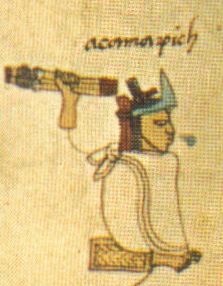
The name of Acamapichtli "handful of reeds",
ruler of Tenochtitlan,  written with
glyphs  and Latin letters.
The glyphs shows a hand holding
a bunch of reeds.


The name of the town of Xochimilco "Flower field place" written with Nahua glyphs:
The squares on the bottom represent a "field" - representing the root MIL- in Nahuatl
and the flowers on top represent the root XOCHI "flower" in Nahuatl.

As can be seen from the examples, we have a pretty good idea about how to read Nahua glyphs (because almost all glyphic texts are accompanied by writing in Latin letters), and generally we know what the say. But there is still some discussion about the principles based on which the Nahua wrote. Scholars have for example discussed if the Nahua simply depicted concepts with pictures, or whether their signs actually represent words and sounds? Today we know that Nahuas seem to have definitely used their signs to represent spoken words and sounds, but specialists are still discussing the technicalities of how the Nahua writing system worked.

Aztec Writing: Logographic? Phonetic? Semasiographic? Rebus-writing? 

The decipherment of Aztec writing is not really the classic kind of situation where we have a lot of long monolingual texts that we are unable to read because we don't know the language or the principles they used to write with, and where a bilingual text (such as the Rosetta stone for Egyptian hieroglyhs, or Landa's syllabary for Maya hieroglyphs) can provide the clues to finally crack the code. On the contrary, we know that Aztec glyphic texts were written in Nahuatl, and they supply us both with the glyphic script, and with a transliteration in to the Latin alphabet, and they often even with a Spanish translation. So most of the time the question is not what the glyphs mean, the question is how they work to give that meaning. Furthermore, most texts written in Aztec glyphs are short, and consist mostly of names of places and people.

Nonetheless, the decipherment of Aztec writing did have to pass through some phases of confusion. Particularly, a phase in which scholars didn't consider it to be a script at all, but just drawings that could only be read non-linguistically. In some sources we can still find the claim that the Aztecs did not have "true writing". The concept of "true writing" in this sense is used to describe the fact that it does not seem the Nahuas wrote long narrative texts using their script. Rather they wrote stories using sequences of pictures, and used the script to name the persons and places who participated in the stories.

The first scholars to note that the Aztec script in fact has a lot of "phoneticism" (i.e. it represents the sounds of spoken language, and not just ideas), were those 19th century antiquarians who first studied the early colonial codices. One of them was Joseph Marius Alexis Aubin, a young French scholar who accompanied Maximilian of Habsburg who went to Mexico with a contingent of French forces because Napoleon III (no, not Bonaparte) had appointed him the new Emperor of Mexico. Aubin had studied Nahuatl in France, and probably also had help from Maximilian's main Nahuatl specialist the Nahua nobleman Faustino Chimalpopoca who had worked with many of the Nahuatl language codices. Reading Aztec maps and tribute lists Aubin (1849 [1885]) realized that all the Nahua rulers and all the cities in the codices had little name glyphs attached to them, and that these name glyphs consisted depicted concepts or words that were part of the name they represented. For example all the places that had the locative ending -pan in their name, had a little flag in their name glyph. "Flag" in Nahuatl is of course pantli or pamitl - so Aubin realized that the flag represented the ending. Aubin deciphered a number of glyphs in this way, by seeing that they depicted short words that could be used both to signify the word they depicted but also words that sounded similarly (e.g. a stone "tetl" signified the syllable TE, a pot "comitl" signified the syllable KO, etc.). And he noted that there was a good deal of systematicity in the way the word signs were used, going as far as describing the system as an écriture syllabique [a syllabic script]. Aubin was particularly inspired by finding a version of the "Pater Noster" written partly in Aztec script - it was apparently used as a medium with which the friars could better teach the Nahuas the catechism. In the Nahuatl script the title said:

Flag            Stone              Cactus               Stone
PAN(TLI)     TE(TL)        NOCH(TLI)       TE(TL)
pa                  te                   noch                  te  

Aubin realized the flag glyph was /pantli/ "flag" representing the root pan, the second symbol was the stylized symbol for /tetl/ "rock" representing the syllable te, the cactus symbol was /nochtli/ representing the root noch (the tli/tl suffix is not part of the stem). The phonetic reading was PA TE NOCH TE - a fairly close approximation of the Latin "Pater Noster" (remember that colonial Nahuatl has no /r/). This convinced Aubin that the Aztec script operated from a syllabic principle - and he considered that Nahuas were already literate in this script when the friars arrived, which why it made sense for the friars to use it.

However, his argument was not very well received. A number of scholars argued that the phonetic signs were introduced by the friars simply using a rebus principle, and that it didnt represent pre-contact usage. Since all of the known texts using the script were from the early colonial period, this was hard to refute, and for many decades the consensus came to be that the Nahua script was not true writing but a "pictographic" form of primitive picture writing. Some scholars argued that Nahua iconography, and central Mexican indigenous iconography in general, is "semasiographic"in character which means that it does not represent a spoken language directly, but rather offered clues to the "reader" through which they can improvise a narrative in whichever language they happen to speak. Nonetheless a number of works on the principles used in Nahua writing were published, by Barlow & McAfee (1954), Dibble (1971), Prem (1992) and Nicholson (1973) - Nicholson particularly argued that perhaps there was a greater degree of phoneticism in precontact Nahua writing than had previously been thought - but the mainstream view continued to be that pre-conquest Nahuas did not "write".

Lacadena's Syllabary:

Lacadena's 2008 Syllabary,
published in PARI journal 8:(4):p. 23
In 2008 a major event happened in Nahuatl writing studies. Spanish linguist and Epigrapher Alfonso Lacadena published an analysis of Nahuatl writing in which he argued that Aubin had been right to call the script "syllabic". Lacadena had previously participated in the work of deciphering the Maya script, and he argued that the Nahua system was essentially similar - combining a set of logograms representing entire words, with a syllabary that could be used to phonetically spell most of the possible syllables of the language - making the system capable of representing spoken language.

Lacadena had been able to arrange the known phonetic elements of the script into a syllabary similar to the Maya syllabary - showing that Nahuas in fact had syllabic signs for almost all the possible syllables in the language. He argued that several of the already recognized signs that had previously been read as logograms ("whole-word signs") in fact ought to be read as syllabograms ("syllable signs") consisting of only a consonant and a vowel - the flag glyph for example ought to be read pa and not PAN,  the pot glyph ko and not KON, etc. He shows that it is possible to demonstrate that some signs that were originally read as logograms, had to be read as syllabograms in certain words. For example the drum sign which had traditionally been read WEWE, he proposed should be read - at least sometimes - simply as we. And he showed this by demonstrating that it was used to write names such as tohuexiuh /towexiw/ where it only represented one syllable, not two.

A very interesting set of readings provided by Lacadena deal with the syllable /wa/ which he shows can be written either with two parallel lines, with two leaves or with a grasping hand. He argues that the two lines come from the verb wawana "to scratch", that the two leaves are amaranth leaves wawtli (Personally, I think they are more likely from ixwa "leaf" and in one of his examples the glyph actually co-occurs with an IX logogram (the eye), suggesting a dual representation of the ix-syllable - but clearly in many other cases it is only read as wa), and that the grasping hand is a logogram based on the possessor suffix -wa' (e.g. in michhua "fish-possessor" or mazahua "deer-owner"). The two former readings he considers syllabograms, while the third he considers a logogram (inspite of not representing a word, but a grammatical morpheme). These readings are very important and constitute an important move towards the syllabary.

The name of Spanish encomendero Luis Vaca written
in Nahua glyphic writing. The bottom sign is an olote (dry maize stalk) (OLO),
then an eyeball (IXand on top two leaves (wa [or maybe (IXWA]), 
the long plate shaped glyph is probably a plate CAX or ca. Giving the full reading (o)LO-IX-WA-KA(X) 

Lacadena demonstrated that as in the Maya (and Egyptian) scripts often the syllabograms were used as phonetic complements, added to logogram to support a specific reading - or even at times to force one of two phonetically distinct readings of the same logogram.

In Lacadena's interpretation the Nahuas had a fully developed logo-syllabic writing system already in the pre-contact period, although he also recognizes that the use of phoneticism may have become more prominent as the Nahua logosyllabic script competed with the Latin alphabet. By setting up the Nahuatl phonetic signs into the syllabary format, Lacadena moved the discussion forward - it was now no longer relevant to discuss the phoneticity itself, from now on the discussion would have to be about the degree of systematicity with which the Nahuas used phonetic symbols.

Whittaker's Challenge:


In 2009, anthropologist and epigrapher Gordon Whittaker challenged Lacadena's vision of how the Aztec script worked. Following earlier work by Hanns Prem, Whittaker had studied the phonetic principles of Aztec writing for awhile and did not agree with Lacadena's strictly syllabic interpretation. In his paper "Principles of Nahuatl Writing" he proposed that rather than being a strict logo-syllabic script, Nahuatl writing allowed a much wider range of possibilities. For example he argued, most of Lacadena's syllable signs could be read both as syllable signs with a consonant and a vowel, but also as logograms including syllable final consonants; and sometimes polysyllabic logograms could be read as syllable signs, selecting just one of their syllables as their phonetic value. In this way the Nahuatl script included both logograms, syllabograms and bisyllabograms. Whittaker therefore suggests that the way that Nahuas read their texts were not as straightforward as Lacadena suggests - they needed access to a wider array of interpretive processes than simply reading the syllabograms. In the example below, the place name Chipiltepec is written with the syllabogram chi (depicting the edible seed "chian"), the logogram HUIPIL"blouse", the logogram TEPE and the syllabogram te used as a phonetic complement.

chi     (hui)pil     TEPE    te
"Chipiltepec"
The interesting part here is that the logogram HUIPIL is not read as a logogram but as a syllabogram, ignoring the first syllable and reading only the second syllable pil. This challenges the strict division Lacadena poses between logograms and consonant-vowel syllable signs.

Whittaker also notes that several of the signs that Lacadena considers syllabograms, can be read both as syllabic Consonant-Vowel (CV) reading, as well as as a Consonant+Vowel+Consonant (CVC) group. For example the "flag" can be read both pa and pan, and the "tooth" can be read both tla and tlan. He seems to consider that the reading with final -n is not a real logogram, because it is not usually used to represent the words "flag" and "tooth", but rather to write the locative endings on place names - locative endings that happen to be homophonous with the words depicted by the logograms, but which have completely different meanings. This is another reason Whittaker considers some of the Nahua signs to be phonetic, but to represent neither CV syllables nor words - but longer sequences such as CVC or even CVCV.

Furthermore, Whittaker implies, it does not seem that Nahuas thought of their phonetic writing as a self-contained closed system in the way that a syllabary is generally thought of. Rather the way he describes the system it is an array of conventions, many of them fairly loose, which the Nahua used in a creative and intuitive way. Whittaker notes for example (in a talk he gave at Yale in May 2016) that the Nahuas used ways of expressing concepts that are unique to the Nahua script. For example they used color of glyphs to convey color words (i.e. the word chichiltepec "red mountain" written as a red mountain where the color of the mountain is used as a logogram).

Whittaker also produces some interesting new readings of specific signs, for example he shows that a worm-shaped glyph can be read COCHIN, based on the word ihcochin "earthworm".  For example the name Tlacochin can be written with a combination of four signs: TLACOCH "javelin", (ih)COCHIN, tla/TLAN "tooth", and co/CON (here I allow for both the possibility of reading these as logograms and as syllabograms, hence the /). Interesting here each syllable (except -in) is spelled phonetically twice - providing no possibility for misreadings. Here, following Lacadena's method, co and tla can be read as syllable signs, and TLACOCH as a logogram. But the worm, spelling syllables COCHIN can neither be a logogram (because the name is likely derived from tlacochtli "spear" and not from ihcochin "earthworm") or a simple syllabogram.

The name Tlacochin written both with Latin letters and with
four Nahua glyphs. It is the wormlike creature on top of the teeth
that Whittaker reads as (ih)COCHIN.

Finally, Whittaker argues, that if the Nahuas indeed thought of their system as a complete syllabary, then it was a very deficient syllabary since there are no known syllabograms for several of the most frequently occurring syllables in the language such as ti, ni, ki, tli, kwa, ya, etc. This would make it impossible to actually represent spoken language using only syllabograms. And this in turn suggests that the Nahuas did not conceive of their phonetic signs as a systematic complete syllabary, but that rather than an organized system the syllabograms formed a repertoire of signs that had grown through accumulation in the course of the Aztec writing tradition. An incipient syllabary perhaps, but not quite there yet.

So, Whittaker and Lacadena agree on considering the Nahua script to be highly phonetic - also in pre-contact times - but they disagree on what kind of system it was, and how Nahua scribes interpreted the phonetic signs. Nonetheless, it doesn't seem that either of the two epigraphers are willing to concede many points to the other. To my knowledge, Lacadena has yet to respond publicly to Whittaker's argument, while Whittaker's papers seem to me to exaggerate some of the differences between the two models (for example the difference between logograms and bisyllabograms isn't very big in practice - it is mostly a question of labeling I think). So where does Nahuatl glyph studies go from here?

My 5 Cents Worth:

While I am not an expert on Nahuatl writing, to conclude I will share my own evaluation of Lacadena's and Whittaker's competing models.

Lacadenas demonstration of pervasive phoneticity of the Nahua script is extremely important, and did inaugurate a new way of looking at the Nahua script. But I am not convinced by the argument that the script can be understood as a strictly logo-syllabic script. Whittaker demonstrates that the script is considerably more flexible than that, including types of signs not known in any other scripts (e.g. the use of color to signify color words), and making more readings available to the reader. I simply dont think that there is a convincing reason to think that Aztec scribes and readers thought of their signs as representing mainly CV syllables rather than for example representing entire word-stems that could e read for their phonetic value as well as as the word-concept they represent. On the other hand I am not sure if Lacadena is actually argueing that the Aztec scribes thought of their script as a syllabary, and that the syllabic interpretation is "psychologically real" - this I think would be a problematic claim. But it is possible, I think, that he simply meant to demonstrate the pervasiveness of syllabic signs in the system to show that it is not as different from the Maya system as it has been claimed. If this is the case I think the point was well-made and Whittaker's argument can simply be considered a demonstration of additional features of the script, that Lacadena did not spend time exploring because his aim was another.

On the other hand, I think Whittaker exaggerates the differences between the two interpretations. Particularly, it seems that Lacadena does allow for many of the readings that Whittaker considers disyllabograms and CVC syllables - he just considers those logograms used according to the rebus principle (Whittaker apparently doesnt like using the word "rebus" for phonetic readings of logograms). This seems to me as a mostly theoretical discussion that doesn't really impinge on our understanding of the script itself. I assume that Lacadena acknowledges that when a logogram can serve the function of expressing another word than the one that is actually depcited, this is indeed a phonetic rather than a logographic reading of the sign.

Some of Lacadena's readings also beg the question about whether each sign really has only one possible reading. For example many of his syllabograms clearly must have originated as logograms, for example the tla- and pa syllabograms which are represented "logographically" with signs that must have been read originally as TLAN and PAN - and which sometimes still are clearly used to write out those exact phonetic sequences with final -n (for example in toponyms). Hence it seems to me that we must concede that these signs are either used sometimes as syllabograms and sometimes as logograms, or that we can simply conclude that the final consonants can sometimes be omitted to produce syllabic readings from logograms. Probably, over time some logograms were conventionalized as being mostly used syllabically, while others kept their double readings. Whittaker produces further evidence for this type of process when he shows that the HUIPIL logogram can be read simply as PIL. And another example would be if I am right that the double leaf symbol was originally and occasionally a logogram IXWA which then became conventionalized as a syllabogram wa. Although the possible alternative  reading of "Luis Vaca" as OLO IX IXWA (where IX is a phonetic complement noting that the leaf sign should be read IXWA and not simply wa), instead of Lacadena's reading OLO IX wa, suggests that maybe two readings continued to coexist).

Where, I think Whittaker's interpretation is strongest is in that it paints a picture of a very different process of writing than Lacadena's  - a process that is highly creative, combining intuitive conventions and a repertoire of established signs with local innovation. I think it is clear that Nahua writing was in many ways unique when compared to other writing systems, for example in being seemingly open-ended, and without many fixed conventions.

In any case, I think any future engagement with Nahua glyphic script needs to take both Lacadena's and Whittakers arguments into account, in order to pick out the important insights of both of them. A question that needs further exploration is how systematic and or flexible the system really was  - what were the limits? Which kinds of readings do we not get that we might? Also additional support for the syllabary could be provided for example if we were to find syllabograms used to spell final consonants in the Maya style (where for example BALAM can be spelled ba-la-ma).

In the end it seems to me that we cannot escape the fact that even though the Nahua script was highly phonetic, and clearly shared principles with the Maya logo-syllabic script, their approach to writing was very different from that of the Maya. Nahuas do not generally seem to have considered it a function of their script to represent spoken language much beyond personal and place names used to label narratives that were represented with pictures. No clear examples of full sentences have been deciphered, and indeed it doesnt seem that the script was even capable of writing such sentences given the lack of syllabograms for such important grammatical morphemes as ni, ti, and ki  which would be necessary to represent almost any slightly complex Nahuatl sentence. [Edit: After publishing this, I was reminded of the long sequences of glyphs found in the Codex Xolotl which may well represent something like full sentences - however I do not believe these have been deciphered yet].


Bibliography:


  • Barlow, Robert H. and Byron McAfee. 1949. Diccionario de elementos fonéticos en escritura jeroglífica (Códice Mendocino). Mexico, D.F.: Universidad Nacional Autónoma de México.
  • Dibble, Charles E. 1971. Writing in Central Mexico. in Gordon F. Ekholm and Ignacio Bernal (eds.), Handbook of Middle American Indians: Archaeology of Northern Mesoamerica, Part 1, Vol. 10, pp. 322-332. Austin: University of Texas Press.
  • Nicholson, Henry B. 1973. Phoneticism in the late Pre-Hispanic Central Mexican writing system. in Elizabeth P. Benson (ed.), Mesoamerican Writing Systems, pp. 1-46. Washington: Dumbarton Oaks
  • Prem, Hanns J. 1992. Aztec writing. in Victoria Reifler Bricker (ed.), Handbook of Middle American Indians, Supplement, Vol. 5: Epigraphy, pp. 53-69. Austin: University of Texas Press.


onsdag den 10. februar 2016

No Snopes.com, the word guacamole does not come from the Nahuatl word for "ground testicles or avocados".


We all know that guacamole is delicious (seriously, if I had to choose one food to eat the rest of my life guacamole would be a strong candidate), but what does the word mean?

Today Snopes.com, usually a good source for debunking of all kinds of myths, wrote about Nahuatl. Unfortunately they got it pretty much backwards, so now I have to write a blog-post debunking the debunkers.(Snopes has since corrected the entry, I give the link at the end of this blogpost)

The myth that Snopes was trying to debunk is that the word "guacamole" comes from a Nahuatl word meaning "testicle sauce". That it does is a meme that sometimes makes the rounds on the internet. (for example here, and here).

After "fact checking" the myth with dictionaries, before rewriting the article the Snopes writer concluded that "Avocado" does indeed come from a Nahuatl word that "also means testicle". But that "mole"  comes from the Spanish word moler "to grind". Neither of these conclusions are entirely correct, but the latter was outright false.

1. The Nahuatl word ahuacatl does not mean testicle. 


The Nahuatl word for the avocado (Persea americana) /a:wakatl/ (variously spelled ahuacatlaguacatlauacatl etc.) comes from a proto-Nahuan word *pawata which also means "avocado" - the word pawatl is still used for wild avocado in some Nahuatl varieties. All Nahuatl dictionaries give avocado fruit as the primary meaning of /a:wakatl/. But does or did the word also mean "testicle"?

A number of English etymological dictionary mention "testicle" in relation to the Nahuatl etymology of Nahuatl. One of them is Merriam-Webster and another is the Etymology Dictionary Online (which a couple of years ago I convinced to change the definition so that it no longer states that the original meaning of Nahuatl ahuacatl was "testicle"). They in turn get their data from Frances Karttunen's 1987 "Analytical Dictionary", the most esteemed Nahuatl-English dictionary, which lists the meaning of ahuacatl as simply "avocado, testicle". Karttunen in turn derives most of her entries from Alonso de Molinas 1571, which gives us the definition as "fruta conocida, o el compañon" (i.e. "a known fruit or the testicle" he uses the now outdated Spanish word compañon for testicle).

So the etymology is sound in the sense that we know that in the 16th century the word was used to refer both to the fruit and the body part - at least by some people in Mexico City where Alonso Molina grew up and learned Nahuatl on the streets with his indigenous friends. We know little more than that though, for all textual references to the word that I have come across use it only in the botanical-culinary meaning. And in Nahuatl speaking communities I have never met anyone who considered the word /a:wakatl/ to refer to anything but avocadoes. Molina himself gives a clue that this is the case because if you look in the Spanish part under compañon. Here, he does not give auacatl as a possible translation only the word atetl, which is a normal, anatomical, non-slang word for testicle in Nahuatl today and clearly also in the past (another common word is xitetl).

It would appear that the anatomical meaning is a euphemism, based on a certain similarity of shape, the same kind of euphemism that we make use of when we refer to a penis as "a wiener" or to testicles as "nuts" (or when Spanish speakers refer to testicles as "huevos" "eggs" or cebollas "onions"). We would however not generally consider it to be "partly correct" to say that "wiener schnitzel" kind of means "Penis schnitzel" or that "nut case" kind of means "testicle box". Nor would Spanish speakers consider it meaningful to say that "torta de huevo" kind of means "testicle sandwich".

So, no the Nahuatl word ahuacatl /a:wakatl/ does not mean "testicle", but because of the evocative shape of the fruit  it can be used metaphorically in that extended sense. And it is this extended sense that Molina recorded.

That was one out for snopes, but the second part is actually worse. Here the snopes writer goes completely off track.

2. The Mexican Spanish word "mole" does not come from Latin "molēre" but from Nahuatl /mo:lli/ "sauce"

She claims that the "mole" part of the word "guacamole" comes from the Spanish "moler" "to grind". This is intuitively plausible because indeed there is a bit of grinding taking place when one converts avocados into guacamole. But that two words look and have a plausible meaning alike of course does not mean that they share the same etymology. In this case there are very good reasons to think that the "mole" part does not come from Spanish, but from the Nahuatl word /mo:lli/ "sauce". The Snopes writer realizes that the word "molli" means sauce, but still she makes the weird claim that the word has now "converged with the infinitive moler". I dont know what this is supposed to mean.

But the main problem is that she was "unable to determine whether it [molli] originated from Nahuatl or entered it as a loan word from Spanish." I can help Snopes with that one: The Nahuatl word molli "sauce" is a noun derived from a root *mo:l that has to do with hard or thick things becoming liquid or soft. We have mo:loa "to dilute a sauce", mo:lehua "for earth to become soft" (and perhaps moloni "to bubble, swirl, flow"though the vowel length doesnt sem to match). So mo:lli most definitely is a native Nahuatl word meaning something like "watery emulsion".

The best reason is the Nahuatl word for guacamole is ahuacamolli, which is easily analyzable as "avocado sauce". The Nahuatl word ahuacamolli, is indeed also the generally accepted source of the Spanish word (even the RAE which is not known for getting indigenous language etymologies right actually gets this one right). But Snopes claims that it is the other way round, that Spanish guacamole was borrowed into Nahuatl as ahuacamolli! This would be a very weird borrowing indeed, since it was Nahuas who taught Spaniards to make ahuacamolli in the 16th century, and since Molina's dictionary (Molina defines auacamolli as a "manjar de auacates con chilli" which appropriately translates as "a feast of avocadoes with chili") and the Florentine codex attest the Nahuatl word in this period - long before the first appearances of the Spanish word. 

So the word guacamole does not come from a word meaning "testicle sauce", nor from a half Nahuatl half Spanish that can be analyzed as meaning "ground avocado" as Snopes.com implicitly suggests. It comes from the Nahuatl word ahuacamolli which means an "avocado based sauce". 

If Nahuas ever used the word as a slang word to refer to semen or other naughty "testicle juices" we will never know, but there is no evidence to suggest that they did.

Also: Pro-tip to Americans: Please stop saying "Guac" when you order guacamole in your burrito at Chipotle Mexican Grill. Whenever you utter this abbreviation a little Nahuatl speaking kitten somewhere dies.

[Update: Brooke Binkowski of Snopes.com has reacted to a link I posted on facebook to this blog, and edited the article which now no longer contains the (mis)information given above. ]


These are not The Hulk's testicles,
even if they do kind of look that way. (Photo from wikicommons)


onsdag den 26. november 2014

Decline of Nahuatl in Morelos (part II)

In my previous post I argued that the state of Morelos was predominantly Nahuatl speaking in 1910. As we know, that is not the case anymore.

In this post, I use three sources to show the decline of Nahuatl in Morelos from 1897 to 2014 graphically.

The earliest source is an 1897 Nahuatl wordlist compiled by Antonio Peñafiel, on the map I plot in all the communities where he collected Nahuatl vocabulary. As a minimum we know that there were Nahuatl speakers in those locations in 1897. In 1941 anthropologist Robert Barlow was involved in a project meant to teach Nahuatl language literacy to the Nahua of Morelos. He tested a group of teachers and the locations of the towns where they were from is plotted in on the map. In 1976 Karen Dakin and Diane Ryesky surveyed Nahuatl in Morelos and found Nahuatl speakers in a couple of communities that I haven't put on this map yet, in Axochiapan and Atlacholoayan. And then today Nahuatl is spoken in 6 communities of which Cuentepec is the only one where it is the main community language spoken by all age groups. In Tenextepango in the municipality of Ayala, the speakers are all originally from Guerrero who arrived in the state within the past 40 years.


I have plotted the towns into this map of the state of Morelos, using different colors to distinguish the age of the last attestation of Nahuatl spoken in the locality in the sources I use. They give a visual representation of the process of decline, starting from the lowlands that were most severely affected by the violence of the revolution. 

Today revitalization efforts are undertaken in Hueyapan,  Xoxocotla, Tetelcingo, Sta. Catarina, Ayala/Tenextepango, and in Coatetelco - so the map may look different 50 years form now again.

Here is my map (please don't use it without attribution to me):


lørdag den 15. november 2014

Nahuatl Names: The Nahuatl names in the 1544 census of Morelos


Lots of people are interested in giving their children Nahuatl names. But finding good ones is hard, the few common names such as Cuauhtemoc, Xochitl aren't quite sending the signals many people are interested in anymore.

But there is very little work done on Nahuatl naming. James Lockhart has a brief analysis of changing naming customs from the early colonial to late colonial period and includes a short list of Nahuatl names in his "Nahuas After the Conquest", but doesnt list nearly as many names as we actually know. Lockhart shows us that across most of Nahua speaking Mexico Nahuatl language names disappear very quickly after the conquest, so the best source of names has to be early documents. To get a sense of what actual common people were named and not just the rulers and nobles it would also be great to have names form some kind of secular everyday context. Luckily we do have that.

In Morelos a large census was carried out in 1544 only 23 years after the invasion when many people were still not baptized and many had lived through the Spanish invasion. We only have three books from this census describing all the families in a number of small communities in Northern Morelos. They are full of names, because every household and its inhabitants are mentioned as well as what they were paying in tribute to the Marques del Valle (Hernan Cortes). This means that in this census we have a large collection of actual names of men, women and children, names that we know were in use right around the time of the Spanish Invasion.

In the following I give a list of many of the names in the census of the communities Huitzillan and Cuauhchichinollan, as published by ethnohistorian Sarah L. Cline, UCLA, 1993. (Read more about the censuses here)

 There are 134 male names, 35 female names and 30 of unknown gender.

I give the names in a standardized "classical" orthography, followed by my interpretation of their full phonological form (sometimes the words appear to be abbreviated or to have sounds missing), and my interpretation of their meaning. The meanings of proper names are not alays clear, so if I have no idea what a name might mean I dont add anything, if I have an idea but am not really sure I add my idea followed by a question mark, and if I am pretty sure about a meaning I just give the meaning.

For some names it is clear from the context that they are either for males or females, but for others, especially those of unmarried children, it is not always possible to be certain if a name is a male name or not. One striking thing is that there is much more variability in male names than in female names, five names account for almost all of the women in the census, necahual, tecapan, teicuh, tlaco and xoco. Teicuh means "someone's older sister", tlaco probably means "middle sibling/daughter".

Necahual is translated as "survivor" around the internet, but this meaning is definitely not a literal one, and I wonder where it comes from. The name clearly comes from the verb cahua "to leave" with an indefinite reciprocal prefix so the meaning of necahua would be "people leave each other". Molina gives the word necahualiztli as "despedida" (farewell/parting), but here we don't have the -liztli ending but a -lli ending that usually gives a "passive" meaning. So in my opinion the word would mean something like "she who has been left behind" or "she with whom people have parted". This could be interpreted as referring to a survivor of warfare, but why would one name ones child that? And furthermore it seems mainly to be a name of adult married women (there are some young girls with the name though). This makes me think that is a name taken by women who have parted with their families and married into another household. If we stick with the "survivor" meaning the fact that mostly married women have it could suggest that these women were taken as war-captives, but since we don't have any evidence for such a practice among the Nahuas I think we can go with the former interpretation.

Tecapan I am not sure what means, and xoco means "fruit".Although there are other interesting female names, overall men's names seem a lot more imaginative. Men also tend to be named after animals much more frequently. many men's names seem to be calendar names.

It seems that some names are dependent on the persons social status such that some names for small children seem to be baby nicknames, later to be replaced with a real name, and some names seem to describe some kind of experience. Perhaps Nahua personal names changed over their lives times.

Many names are derived from nouns, but lack the absolutive suffix (and also sometimes the agentive suffix -qui). In the morphological form I add these suffix when I believe that is the case, because I think it is taken off optionally when it is used as a personal name or predicate. Other names are derived from verbs and give "active" names describing the person or something they did.

I'll be filling in new meanings and analyses as I go a long looking up the difficult ones. I have half-assedly tried to mark vowel length to help pronunciation, but there are still lots of long ones unmarked.

The source of all these names is:
Cline, Sarah L., ed. The book of tributes: early sixteenth-century Nahuatl censuses from Morelos (Museo de Antropología e Historia, Archivo Histórico, Colección antigua, vol. 549). Vol. 81. University of California at LA, 1993.


Women and girl's names:
Necahual /nēkāwal/ "farewell/despedida", "someone who has parted"
Teicuh /tēikw/ "someone's sister"
Tlaco /tlahko/ "middle"
Xocoyotl /xokoyotl/  "youngest sibling"
Xochiatlapal /xochiatlapal/ "flower wing"
Cocoliloc, /kokolīlok/ "she is hated"
Xoco /xoko/ “fruit”
Teyacapan /tēyakapan/ "in front of someone"
Ichpochton /ichpochtōn/ "little daughter"
Yaoxochitl /yāōxōchitl/ "enemy flower (a name for marigold)"
Ocoxochi /okoxōchitl/ "pine flower"
Nahuatl /nāwatl/ "clear sound"
Tecapan /tekapan/ ?
Teyauh /teyawtli/ "marigold/tagetes"
Ilhuicacihuatl /ilwikasiwātl/ "sky woman"
Teichpoch /tēichpoch/ "someone's daughter"
Tematlalehua /tēmatlalewa/ "she bruises people"?
Centehua /sēntewa/ "owner of one (stone)?"
Xochitl /xōchitl/ "flower"
Teicuhton /tēikwtōn/ "little older sister"
Mocel /mosēl/ "she is alone"
Xilotl /xilotl/ "young corncob"
Coaxoch /kōwaxōchitl/ "snake flower"
Cozcamichiuhtecatl /koskamichiwtekatl/ "fishnecklace person?"
Tlacoehua /tlahkoēwa/ "she gets/sits up halfway?"
Mauhcaxochitl /mawkaxōchitl/ "scared flower"
Cihuacocoxqui /siwākokoxki/ "sick woman"
Papanton /papantōn/ "little banner"
Tlacoton /tlahkotōn/ "little half"
Cecihuatl /sēsiwātl/ "one woman"
Cihuaton /siwatōn/ "little woman"
Tepi /tepi-(tōn)/ "tiny" 
Cihuanen /siwānen/ "female walker? (if nen under stood as an abbreviation of nenqui "someone who walks") "woman in vain?' (if nen is understood as related to nen- doing something in vain)'
Chopinton /chopintōn/ ?


Men and boy's names:
Yaotl /yāōtl/ "enemy"
Omacatl /omakatl/ "two reed" (a day of the calenedar, and an epithet of the God Tezcatlipoca)
Tecuetlaza /tekwehtlasa/ "he throws (like) a Mexican beaded lizard" (if tecue is understood to be Tecueh the mexican beaded lizard, the Mexican cousin of the Gila monster, common in Morelos)
Itzcuin /itskwin/ "dog", maybe a day-sign name
Xochiquen /xochikemitl/ "flower garment"
Yaquica /yaquisa /yakika/ of unkown meaning or pehaps /ya(o)kisa/ "he goes to war"
Quenmachoc /kenmachok/ ?
Matlalihhuitl /matlalihwitl/ "purple feather"
Quauhtli /kwawtli/ "eagle" maybe a day-sign name
Teuhcatl / tewkatl/ "dust person" 
Coatl /kōwatl/ "snake", maybe a day-sign name
Quaquauh /kwakwaw/ "horn"
Pantli /pantli/, "banner", maybe a daysign name
Huehuetl /wēwetl/ "old one", maybe an age related name
Acotlehuac /ahkotlewak/? "toasted shoulder?" if tlewak is understood as an abbreviation of tlehuacqui "toasted".
Temilo /temilo/ "he is filled up"? If interpreted as the verb temi "fill up" in the impersonal/passive form
Tecocoa /tēkokoa/ "he hurts people" 
Yaquin /yakin/ ?
Tlatlazaloc /tlahtlasalok/ "he has been thrown"
Tlapoca /tlapoka/ "he smokes"
Quauhtemoc /kwawtemok/ "he descended eagle-like"
Poton /potonki/ "he stinks" (interpreted as abbreviation of potonqui)
Pacoatl /pahkōwatl/ "medicine snake"
Olopatzicatl /olopatzikatl/ olotl is the hard core of the corn cob, tzikatl is an ant, I have no idea how to fit the pa in or what the meaning would be.
Mimich /mimich/ "little fish"
Cihuacoatl /siwakōwatl/ "woman snake" (a noble title)
Nacxitl /nakxitl/ This word is of unkown meaning, but probably contains the word ikxitl "foot", it is famous as one of the names of the legendary ruler "Topiltzin Quetzalcoatl"
Tototl /tototl/ "bird"
Tochhua /tōchwa/ "rabbit owner"
Zolin /solin/ "quail"
Pihuiyol /piwiyol/ ?
Nauhyotl /nawyotl/  "fourth"
Tenicahuehue /tenikawēweh/
Mito /mi(h)to/ ?
Axolin /axolin/ “salamander”? Axolin could be a variant of axolotl “salamander”.
Quiachton /kiachtōn/ ?
Quauhtlapochin /kwawtlapochin/
Tlacuiton /tlakwitōn/ "little taken thing" if from tlacuitl "something taken"
Ecaton /ekatōn/ "little wind"
Nochhuetl /nochwetl/ ? Seems to be related to nochtli “cactus fig”
Huehuetecatl /wēwetekatl/ "old person/person from the ancient place"
Ilcahualoc /ilkāwalok/ "he is forgotten"
Chichiton /chichitōn/ "little dog/puppy"
Tenoch /tenochtli/ "stone cactus"
Telpoch /telpochtli/ "young man", probably an age related name
Ticocnahuacatl /tikoknawakatl/ ?
Huecamecatl /wekamekatl/ ?
Tlilli /tlilli/ "black ink"
Tetzauh /tetzawitl/ "wonder/miracle/surprise" 
Itzcotocatl /itzkotokatl/ "cut by obsidian?"
Popocatl /popokatl/ "smoke person"
Motolinia /motolinia/ "he torments himself" 
Cuilol /kwilol/
Chichatlapal /chichatlapal/
Tetepon /tetepon/ "short one"
Mecahuehue /mekawēweh/
Quetzal /ketzalli/ "precious plume"
Mizyaotl /misyāōtl/ "cat enemy"
Xiuhcozcatl /xiwkoskatl/ "greenstone necklace"
Acatlo /akatlo/ ?
Ollacatl /ōllākatl/ "rubber man"
Chiucnahuacatl /chikwnāwakatl/ "9 person?"
Huelitl /wēlitl/ ? Probably related to wēli “be able to” or wēlik “delicious”
Elotl /ēlotl/ "corn cob"
Huitznahuatl /witznāwatl/ "person from the south?"
Zacahuehue /sakawēwe/ "old grass man"?
Chimalpepech /chimalpepechtli/ "mended shield"
Acopa /ahkopan/ "upwards"
Tezcacoacatl /teskakōwakatl/ "mirror snake person"
Toqual /tokwal/ “our good thing”?
Caltecatl /kaltekatl/ "house dweller"
Tlilquen /tlilkemitl/ "black garment"
Tepeyacan /tepeyakanki/ "mountain leader"
Chalmecatl /chalmekatl/ "person from chalman (chalma)"
Tlillanhuehue /tlillanwēwe/ "old man from the ink place"
Milli /milli/ "cornfield"
Pozon /posonki/ "boiled one"
Xochihua /xochiwa/ "flower owner"
Mexicatl /mexikatl/ "mexican" (Person from Mexihko-Tenochtitlan)
Teuctlamacazqui /tekwtlamakaski/ "lord priest"
Molotecatl /molotekatl/ "person from molotlan"
Tlailotlac /tlailotlak/ "dirty one?" 
Yaotlhuehue /yāōtlwēwe/ "old enemy"
Coyolton /koyoltōn/ "little bell"
Tecocol /tekokol/ "someone's anger"
Tlacateotl tlākatēotl/ "man-god"
Tlilpotonqui /tlilpotonki/ "he stinks black"?
Cuima /kwima/ ?
Tlacatecpanecatl /tlakatekpanekatl/ "Person from the palace"
Nequametl /nekwāmetl/ "juicy maguey"
Yaonemitl /yāōnemitl/ "enemy arrow"?
Tenahuac /tenāwak/ "close to someone"
Aquahuitl /ākwawitl/ "water tree"
Tlapayauh /tlapayaw/ "it became dark"
Xochiteotl /xochiteotl/ "flower god'
Tlohui /tlowi/ "Buzzard"? If related to tlohtli "Buzzard"
Molotl /molotl/ ?
Quennel /kennel/ "like truth"? 
Huetl /wetl/ ? maybe like chatl/chantli this is really a local dialectal variant of huentli "sacrifice/offering" then it would be /wentli/ with the n and last i elided.
Tematl /tematl/ ?
Cihuatecpanecatl /siwātekpanekatl/ "person from the women's palace"
Chatl /chatl/ ? Cline suggests that it is actually chantli /chantli/ "home" based on the way that the manuscript sometimes omits n's and final i's.
Itzmalli /itsmalli/ "obsidian prisoner"
Tziuhcoatl /tsiwkōwatl/
Epcoatl /epkōwatl/ Name is known as a noble name, but the meaning is unclear
Cozauh /kosawtli/ "weasel"
Xolotecatl /xolotekatl/ "person from Xolotlan"
Tenan /tenan/ I think this is most likely an abbreviation of tenamitl "fortification", otherwise it would mean "someone's mother" which seems rather odd for a male name.
Coyotl /koyotl/ "coyote"
Xochinahual /xochināwal/ "flower sorcerer"
Cihuapan /siwapan/ "on top of women?"
Chicotl /chikotl/ "bumblebee"
Ihhuitl /ihwitl/ "feather"
Tonal /tōnal/ "day"
Mamaz /mamas/ "little deer?" 
Maceuhqui /masewki/ "he deserved'
Amiztlato /amistlatoh/ ?
Cecuiztli /sekwistli/ "cold"
Tequitl /tekitl/ "work'
Tonecocal /tonekokal/ ?
Mixcoatl /mixkōwatl/ "cloud serpent" (Name of a deity)
Ecatl /ekatl/ "wind"
Quauhtliztac /kwaktlistak/ "white eagle"
Chalchiuh /chalchiwitl/ "greenstone"
Tlahtol /tlahtolli/ "word"
Quahuitl /kwawitl/ "tree"
Acol /ahkol/ "shoulder"
Tlahuizcal /tlawiskal/ "rosy light of dawn"
Tochtli /tōchtli/ "rabbit"
Xelhuan /xelwan/ ?
Nencahuitl /nenkāwitl/ "time in vain"?
Itzmiquiztli /itzmikistli/ "death by obsidian/sacrifice"
Yopicatl /yopikatl/ "Me'phaa person" The oto-manguean people called Me'phaa or Tlapanecos in Spanish were called yopi by the Nahuas. Perhaps this person came from the Me'phaa area in Guerrero.
Tozmacue /tosmakwe/ ?
Tozcuecuexcatl /toskwekwexkatl/ ?
Macuilhuehue /makwilwēwe/ "five old man'
Tetlacatl /tetlakatl/ "stone man'
Tolnahuacatl /tolnāwakatl/ "person from a place close to reeds"
Mixcoatlailotlac /mixkoatlailotlak/ ? clearly includes the name of the deity mixcoatl, and what seems to be a word for dirt tlaillotl
Anahuaca /ānāwakatl/ "person from Anahuac (the Mexico basin)"


Unkown gender:
Cihuacuitlapil /siwākwitlapil/ "women's tail" probably a nickname for a young child
Quiauh /kiyawitl/, rain, maybe a day-sign name, probably male 
Matlalaca /matlalakatl/ "purple reed" 
Izcahuatl /iskāwatl/ ?
Qualchamitl /kwalchamitl/ ?
Nahualquizqui /nāwalkiski/ "he came out of sorcery?"
Tepiton /tepitōn/ "little one", probably a nickname for a young child
Tohuacochin /towakochin/ ?
Ozoma /osomahtli/ "monkey", maybe a day-sign name, probably male 
Ecatlatoa /ekatlahtoa/ "s/he speaks like wind"
Tlaocoyoa /tlaokoyoa/ "s/he' is sad"
Cochcanauh /kochkanawtli/ "sleeping duck?"
Matlal /matlalli/ "purple"
Metzaol /metzaol/ "maguey scraping"?
Namiton /namiktōn/? "little spouse?" probably a nickname for a child
Mocauhqui   /mokāwki/ "s/he left him/herself behind"
Yaotlachinol /yāōtlachinol/ "destruction of war"
Xihuitl /xiwitl/ "year/comet/herb"
Tecolotl /tekolotl/ "owl"
Yecatlahua  /yekatlawa/
Tecuizolli /tekwizolli/
Huitznecahual  /witznekāwal/
Chicueton  /chikwetōn/
Ixpanton /ixpantōn/
Ahuilizatl /awilisātl/
tziuhtla  /tziwtla/
temoc /temok/ "s/he descended"
chapopo /chapopo/ “tar”?
Maya /maya/ ?
acmachquichiuh /ac mach quichiuh/ “who didnt do anything?”
quauhquimichin, /kwawkimichin/ "wood mouse" 
cipac /sipaktli/ "crocodile/caiman", maybe a daysign, probably male
pancoz /pankos/ “yellow banner” if from pamitl+kostik
miquiz, /mikistli/ "death", maybe a day-sign, probably male
huitziltemoc, /witziltemok/ "s/he descended colibri-like"